AI Appraisal Estimate

AI-generated estimates · not official valuations

From the user

What was submitted

Photo and notes provided by the user — not generated by AI

Submitted item photo
Submitted photo · June 6, 2026

User's notes

No additional notes provided.

AI analysis below

AI appraisal

AI analysis & estimate

AI-Generated · Verify before acting

Everything below is generated by AI for informational purposes only. AI can make mistakes — the AI may misidentify items or misattribute them (artist, maker, brand, designer, origin, era). This is not an official valuation and should not be used for insurance, sale, tax, estate, legal, or lending purposes — or any decision requiring a certified appraisal. It is not an authoritative claim about any person, brand, or rights holder — do not share or rely on it as a factual statement about a third party. Always consult qualified professionals before making financial decisions.

Read the full disclaimer

AI Identification

·Not independently authenticated·Verify before acting

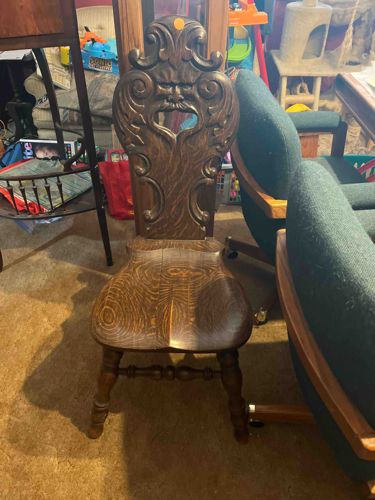
Carved Oak 'Green Man' Side Chair

Furniture

AI Estimated Value

·Not an official valuation·Verify before acting

$600-900

As of June 6, 2026

AI Item Analysis

·AI can make mistakes·Verify before acting
This is a vintage side chair, likely a desk or dining chair, crafted from what appears to be oak, showcasing a prominent fumed finish that accentuates the wood grain. The chair features a highly ornate, carved backrest. The central motif of the backrest is a detailed "Green Man" or bearded face, emerging from foliate designs and scrolls which are deeply carved into the wood. This carving is both intricate and expressive, with swirling patterns suggesting foliage or stylized hair and beard. The backrest shows a cutout opening below the carved face. The seat is solid and features a saddle-shaped or contoured design for supposed comfort, indicating it was carved from a thick plank of wood. The legs are turned and connected by stretchers towards the bottom for stability. The overall condition appears consistent with age, exhibiting a rich, dark patina. There are no obvious signs of significant damage like breaks or large chips, but typical wear and tear appropriate for a piece of its presumed age are present, such as minor scratches or dings on the wooden surfaces. The craftsmanship suggests a sturdy and well-made piece, characteristic of late 19th to early 20th-century American furniture, possibly from the Arts and Crafts or Art Nouveau period, given the naturalistic carving and robust construction.


AI Appraisal Report

·AI can make mistakes·Verify before acting
This Carved Oak 'Green Man' Side Chair presents as a robust and visually striking piece, likely dating from the late 19th to early 20th century. Based on my visual examination, the fumed oak finish appears original and has developed a desirable dark patina consistent with age. The standout feature is the intricately carved 'Green Man' motif on the backrest, which speaks to either Arts and Crafts or Art Nouveau influences, both periods valuing naturalistic forms and craftsmanship. The deep carving suggests skilled artistry. The chair's condition seems good for its age; I observe no obvious structural damage such as cracks or major repairs, which is crucial for antique furniture. Expected minor surface wear, typical of a frequently used item like a desk or dining chair, is present. The contoured solid seat and turned legs with stretchers reinforce its sturdy construction. Market conditions for such pieces are steady for well-preserved, characterful pieces. "Green Man" carvings add an intriguing, often sought-after, element that can elevate desirability over standard oak chairs. Comparables would include other carved oak chairs from the Arts and Crafts period, although the specific "Green Man" motif makes it somewhat rarer than simpler designs, potentially increasing demand among niche collectors. My primary limitation in this appraisal is the lack of physical examination. While the visual evidence strongly suggests authenticity and good condition, I cannot definitively confirm wood species, joinery integrity, or detect subtle repairs or restorations from images alone. A hands-on inspection would allow me to thoroughly check for any hidden damage, assess the stability of the joints, and verify the originality of all components. Provenance documentation, if available, would also be invaluable in confirming its history and origin. Furthermore, scientific testing (e.g., carbon dating for the wood) is not feasible via image analysis, though it's rarely necessary for pieces of this era unless significant doubts arise.

Get your items appraised

Instant estimates of your treasures with AI-powered appraisals

Browse More Appraisals