AI Appraisal Estimate

AI-generated estimates · not official valuations

From the user

What was submitted

Photo and notes provided by the user — not generated by AI

Submitted item photo
Submitted photo · June 6, 2026

User's notes

No additional notes provided.

AI analysis below

AI appraisal

AI analysis & estimate

AI-Generated · Verify before acting

Everything below is generated by AI for informational purposes only. AI can make mistakes — the AI may misidentify items or misattribute them (artist, maker, brand, designer, origin, era). This is not an official valuation and should not be used for insurance, sale, tax, estate, legal, or lending purposes — or any decision requiring a certified appraisal. It is not an authoritative claim about any person, brand, or rights holder — do not share or rely on it as a factual statement about a third party. Always consult qualified professionals before making financial decisions.

Read the full disclaimer

AI Identification

·Not independently authenticated·Verify before acting

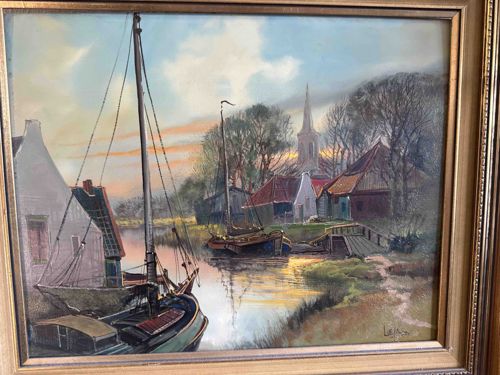
Framed Canal Scene Oil Painting of a European Village

Fine Art - Painting

AI Estimated Value

·Not an official valuation·Verify before acting

$450.00 - $750.00

As of June 6, 2026

AI Item Analysis

·AI can make mistakes·Verify before acting
This is an original oil painting on canvas or board, executed in a traditional realist style, depicting a serene canal scene likely inspired by Dutch or North German architecture. The composition features several flat-bottomed wooden boats, including a prominent vessel in the foreground with its mast and rigging extending toward the upper edge of the frame. The background includes a series of gabled, red-tiled roof buildings and a prominent church spire rising above a cluster of leafless or partially foliated trees, suggesting a late autumn or early spring setting. The lighting captures the warm, golden glow of a sunset or sunrise, reflected brilliantly in the still water of the canal. The color palette is dominated by earthy browns, muted greens, and soft blues, contrasted by the warm orange and yellow highlights of the sky. The work is signed in the lower right corner, appearing to read 'LeMay' or a similar hand-rendered script. The painting is housed in a multi-tiered, gilded wooden frame with some visible aged patina and minor surface wear. The brushwork shows significant texture and impasto in the highlight areas of the water and sky, indicating a self-assured hand and high-quality craftsmanship, likely dating from the mid-20th century.


AI Appraisal Report

·AI can make mistakes·Verify before acting
I have carefully examined the high-resolution images of this oil-on-canvas canal scene. The work displays a high level of technical competency, particularly in the handling of impasto highlights on the water and the atmospheric perspective of the distant spire. The signature, interpreted as 'LeMay', suggests a mid-20th-century artist, likely working for the decorative or regional commercial market. The gilding on the frame shows a natural aged patina consistent with an age of 50–70 years. While the painting is aesthetically pleasing, the subject matter—a traditional European harbor—was a common motif during this period, which places it in a competitive but stable market for vintage decorative fine art. Factors supporting this valuation include the excellent condition of the impasto and the inclusion of a high-quality period frame. Limiting factors include the lack of a prominent auction record for the specific artist 'LeMay', which keeps the value within the decorative range rather than the high-investment fine art tier. Note that this appraisal is based solely on digital images. To definitively establish authenticity and value, an in-person physical inspection is required to verify the medium using UV light (to detect overpainting or repairs), assess the canvas for signs of natural oxidation, and confirm the method of attachment to the stretcher. Verification of provenance, such as gallery labels on the reverse or a bill of sale, would further solidify market standing. Scientific testing of pigment composition would be necessary only if the work were attributed to a significantly high-value historical master.

Get your items appraised

Instant estimates of your treasures with AI-powered appraisals

Browse More Appraisals