AI estimate as of September 24, 2025 · verify with a professional before acting
AI-Generated · Verify before acting
Everything on this page is generated by AI for informational purposes only. AI can make mistakes — the AI may misidentify items or misattribute them (artist, maker, brand, designer, origin, era). This is not an official valuation and should not be used for insurance, sale, tax, estate, legal, or lending purposes — or any decision requiring a certified appraisal. It is not an authoritative claim about any person, brand, or rights holder — do not share or rely on it as a factual statement about a third party. Always consult qualified professionals before making financial decisions.
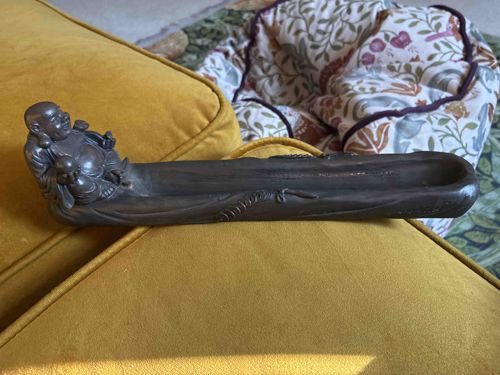
This item is a decorative incense burner featuring a reclining Happy Buddha (also known as Budai or Hotei) at one end. The overall construction appears to be cast from a dark, metallic material, possibly bronze, cast iron, or a resin with a metallic finish, displaying a consistent dark brown to black color with subtle hints of lighter metallic sheen in areas where light catches the surface. The Buddha figure is depicted in a jovial, reclined pose, holding a round object, possibly a pearl or a small bag, in his hands. His facial features are characteristic of Budai, with a broad smile, exposed belly, and large earlobes, conveying an image of contentment and prosperity. The detail on the Buddha figure is moderately intricate, showcasing folds in his robes and jovial expression. The burner itself is an elongated, shallow trough designed to hold stick incense, with a raised lip around the edges to contain ash. Along the side of the trough, there are decorative, relief carvings that resemble swirling clouds or stylized foliage, adding to its aesthetic appeal. The item exhibits a smooth, aged patina consistent with its dark material, suggesting either genuine age or a deliberate antique finish. There are no immediately obvious chips, cracks, or significant damage, and the surface appears to be in an overall good, well-maintained condition. The style suggests it could be East Asian inspired, likely 20th century, possibly contemporary. Its craftsmanship indicates a mass-produced decorative item, yet with sufficient detail to be attractive.
AI Appraisal Report
Based on my visual examination of the Happy Buddha Incense Burner, I assess its condition to be good, exhibiting a consistent dark brown to black color with an aged patina. There are no visible chips, cracks, or significant damage, suggesting it has been well-maintained. The detailing on the reclining Buddha and the decorative relief carvings along the trough are moderately intricate.
Authenticity is difficult to ascertain definitively from images alone. While the style is clearly East Asian inspired, likely depicting Budai (Happy Buddha), the casting material appears to be a dark metallic substance. Without physical inspection, I cannot confirm if it is bronze, cast iron, or a resin with a metallic finish, which significantly impacts value. The craftsmanship suggests it is a mass-produced decorative item, likely from the late 20th century or contemporary.
Market conditions for decorative incense burners of this type are generally stable, but demand is for items that are visually appealing and functional rather than rare antiques. Comparables in the online marketplace for similar cast metal or resin Budai incense burners typically range from $20 to $100, depending on size, material, and origin. This item does not appear to possess exceptional rarity or historical significance. Factors impacting its value negatively include its probable mass-produced nature and the uncertainty of its material. Factors positively influencing its value are its good condition and attractive, detailed design.
For full authentication and a more precise valuation, an in-person examination would be crucial to determine the exact material composition and casting technique. Provenance documentation, if available, could also shed light on its age and origin. Scientific testing, such as XRF analysis, would confirm the metallic composition.