AI estimate as of November 15, 2025 · verify with a professional before acting
AI-Generated · Verify before acting
Everything on this page is generated by AI for informational purposes only. AI can make mistakes — the AI may misidentify items or misattribute them (artist, maker, brand, designer, origin, era). This is not an official valuation and should not be used for insurance, sale, tax, estate, legal, or lending purposes — or any decision requiring a certified appraisal. It is not an authoritative claim about any person, brand, or rights holder — do not share or rely on it as a factual statement about a third party. Always consult qualified professionals before making financial decisions.
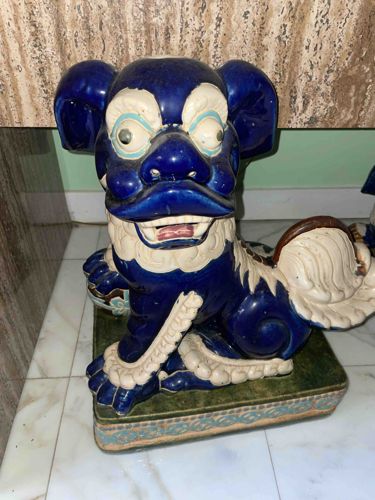
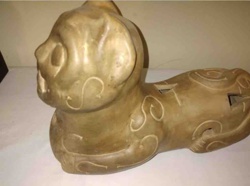
This item is a ceramic statue depicting a mythical 'Foo Dog' or Imperial Guardian Lion, characterized by its vibrant cobalt blue and off-white glazes. The figure is seated on a rectangular base, with its posture suggesting a protective stance. Physically, the statue features prominent, round, floppy ears, large bulbous eyes with light blue iris details, and a distinctive snout-like mouth with visible teeth and a pinkish red tongue, conveying a fierce yet somewhat whimsical expression. The body is predominantly a rich, glossy blue, adorned with contrasting off-white details that define its mane, fur tufts around the legs, and a stylized tail that sweeps upwards. The paws are also delineated in blue, with white, textured accents indicating claws or decorative elements. The base of the statue is a mottled green with lighter green and blue patterned borders, suggesting a celadon or jade-like hue, which complements the main figure. The ceramic material appears to be earthenware or stoneware, coated with a thick, crackled glaze that hints at age. There are no obvious signs of chips or significant damage visible in the provided image, though minor surface wear consistent with age and handling would be expected. The overall aesthetic points to an East Asian influence, likely Chinese, and given the traditional design and glazes, it could date from the mid-20th century or earlier, though reproductions are also common. The craftsmanship appears to be of good quality, with well-formed details and a rich, appealing color palette, making it a decorative piece often used in pairs to flank entrances or significant objects.
AI Appraisal Report
I have examined the provided image of this Blue and White Ceramic Foo Dog Statue. Visually, the condition appears good, with no obvious chips or cracks. The crackled glaze is consistent with older ceramic pieces, but could also be intentionally created in newer reproductions. The vibrant cobalt blue and off-white glazes, along with the traditional Foo Dog depiction, suggest an East Asian, most likely Chinese, origin. The craftsmanship appears to be of decent quality, with well-defined features.
Regarding authenticity, it is challenging to definitively determine age and origin from images alone. While the style points to a classic design, reproductions of such decorative items are common. An in-person examination would be crucial to assess the true nature of the clay body, the application of glazes, and the extent of genuine age-related wear versus artificial aging. Provenance documentation, such as receipts or exhibition history, would significantly aid in authentication. Scientific testing of the ceramic and glazes could provide definitive dating.
Considering market conditions, decorative Foo Dog statues have a consistent but not extremely high demand unless they possess significant age, artistic merit, or historical provenance. Comparables for similar decorative ceramic Foo Dogs, especially without confirmed age or artistic attribution, typically fall within a modest range. The 'fierce yet whimsical' expression is appealing for collectors of decorative arts. Its value as a single piece is also less than a complete, well-matched pair.
Based solely on visual assessment from the image, and assuming it is a decorative piece from the mid-20th century or a good-quality modern reproduction, I would place its appraisal value in the range of $150-250. This estimate accounts for its decorative appeal and apparent good condition, while acknowledging the limitations of remote authentication.