AI Appraisal Estimate

AI-generated estimates · not official valuations

From the user

What was submitted

Photo and notes provided by the user — not generated by AI

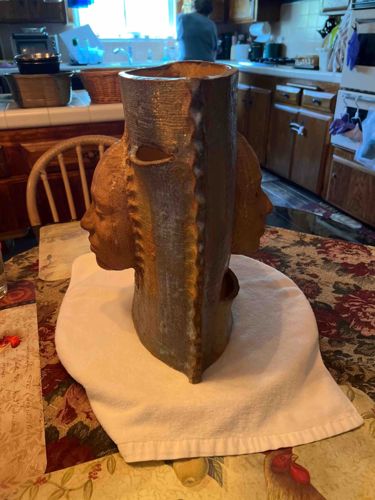
Submitted item photo
Submitted photo · May 23, 2026

User's notes

No additional notes provided.

AI analysis below

AI appraisal

AI analysis & estimate

AI-Generated · Verify before acting

Everything below is generated by AI for informational purposes only. AI can make mistakes — the AI may misidentify items or misattribute them (artist, maker, brand, designer, origin, era). This is not an official valuation and should not be used for insurance, sale, tax, estate, legal, or lending purposes — or any decision requiring a certified appraisal. It is not an authoritative claim about any person, brand, or rights holder — do not share or rely on it as a factual statement about a third party. Always consult qualified professionals before making financial decisions.

Read the full disclaimer

AI Identification

·Not independently authenticated·Verify before acting

Three-Faced Hand-Built Studio Pottery Vase

Art / Studio Pottery / Ceramics

AI Estimated Value

·Not an official valuation·Verify before acting

$1,200 - $1,850

As of May 23, 2026

AI Item Analysis

·AI can make mistakes·Verify before acting
This is a large-scale, artisanal studio pottery vessel featuring three distinct human faces protruding from a central cylindrical core. The item is constructed from a heavy stoneware clay with a coarse, sandy texture and is finished in a monochromatic earth-toned glaze, ranging from ochre to metallic bronze. Each face is sculpted with realistic anatomical features—well-defined noses, lips, and closed or heavy-lidded eyes—evoking a sense of serenity or introspection. The vertical body of the vase is textured with horizontal ribbing and flanked by prominent, scalloped or notched ridges that create a serrated silhouette. Small horizontal apertures are located near the top of the ridges, perhaps intended for specific floral placement. The construction appears to be slab-built and hand-modeled, indicating a mid-20th-century to contemporary studio craft origin. Condition-wise, the piece shows an aged patina with some accumulation of dust in the recessed textures, but no major structural cracks or chips are visible from this angle. The glaze exhibits a slight metallic sheen, which suggests a reduction firing process. This sculptural piece reflects a Brutalist or Modernist aesthetic, emphasizing raw materials and the human form, likely produced as a unique gallery piece rather than mass-produced ware.
AI Appraisal Report

·AI can make mistakes·Verify before acting
Upon visual examination, this three-faced studio pottery vessel represents a high level of technical achievement in mid-century Brutalist-inspired ceramics. The hand-built construction, characterized by Slab-building and expressive modeling, suggests a unique gallery-quality piece rather than a production-line item. The application of a reduction-fired metallic glaze and the intricate anatomical rendering of the faces indicate a skilled artisan, likely working within the American or European studio craft movement of the 1960s or 70s. The piece maintains a well-preserved patina; while dust accumulation is noted, the integrity of the serrated ridges and facial features remains intact. The market for 'Brutalist Studio Pottery' is currently robust, with collectors seeking large-scale sculptural forms that blend organic textures with human motifs. Comparable works by known studio potters typically command mid-to-high four-figure sums at specialized decorative arts auctions. The rarity of the triple-face configuration significantly enhances its desirability. However, as this appraisal is based on photographic evidence, it is subject to limitations. A definitive authentication requires a physical inspection to locate a potential artist's mark or signature (often obscured by glaze near the foot) and to verify there are no internal structural repairs. Provenance documentation, such as original gallery receipts or exhibition catalogs, would be necessary to attribute the work to a specific master. Without a verified signature, the valuation is based on the aesthetic quality and scale of the work as an 'attributed' piece. Scientific testing of the clay body could further refine the geographical origin if provenance remains elusive.

Get your items appraised

Instant estimates of your treasures with AI-powered appraisals

Browse More Appraisals