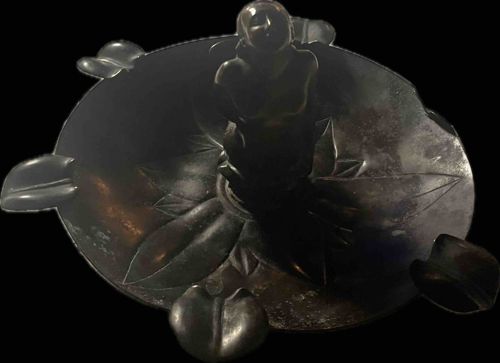
Art Nouveau Bronze Figural Ashtray with Water Lily Motif
Antique Decorative Metalwork

Art Nouveau Bronze Figural Ashtray with Water Lily Motif

This is a circular figural ashtray or catch-all tray cast in bronze with a deep brown-to-black patina. The piece features a central sculptural figure, likely a stylized female nymph or water spirit, emerging from a cluster of water lilies. The base of the tray is decorated with low-relief etched or cast water lily leaves spreading outward from the center. Extending from the curved rim are four small, integrated rests shaped like individual lotus leaves or pads, designed to hold cigarettes or small items. The construction is solid cast metal, exhibiting the flowing, organic lines characteristic of the Art Nouveau period, likely dating from the late 19th to early 20th century (circa 1890-1915). Its condition shows significant age-related wear, including heavy tarnish, oxidation, and surface grime. There are visible areas of uneven patina and what appears to be minor surface abrasions and pitting, particularly on the right side of the bowl. No maker's marks are visible from this angle, though such pieces were commonly produced by European foundries in France or Austria during the Belle Époque. The craftsmanship is high-quality, evident in the detailed veining of the leaves and the anatomy of the central figure.
Estimated Value

$350 - $550

Basic Information

Category

Antique Decorative Metalwork

Appraised On

January 26, 2026

Estimated Value

$350 - $550

Item Description

This is a circular figural ashtray or catch-all tray cast in bronze with a deep brown-to-black patina. The piece features a central sculptural figure, likely a stylized female nymph or water spirit, emerging from a cluster of water lilies. The base of the tray is decorated with low-relief etched or cast water lily leaves spreading outward from the center. Extending from the curved rim are four small, integrated rests shaped like individual lotus leaves or pads, designed to hold cigarettes or small items. The construction is solid cast metal, exhibiting the flowing, organic lines characteristic of the Art Nouveau period, likely dating from the late 19th to early 20th century (circa 1890-1915). Its condition shows significant age-related wear, including heavy tarnish, oxidation, and surface grime. There are visible areas of uneven patina and what appears to be minor surface abrasions and pitting, particularly on the right side of the bowl. No maker's marks are visible from this angle, though such pieces were commonly produced by European foundries in France or Austria during the Belle Époque. The craftsmanship is high-quality, evident in the detailed veining of the leaves and the anatomy of the central figure.
Get Your Items Appraised

Instant estimates of your treasures with AI-powered instant appraisals

Browse More Appraisals