AI estimate as of October 2, 2025 · verify with a professional before acting
AI-Generated · Verify before acting
Everything on this page is generated by AI for informational purposes only. AI can make mistakes — the AI may misidentify items or misattribute them (artist, maker, brand, designer, origin, era). This is not an official valuation and should not be used for insurance, sale, tax, estate, legal, or lending purposes — or any decision requiring a certified appraisal. It is not an authoritative claim about any person, brand, or rights holder — do not share or rely on it as a factual statement about a third party. Always consult qualified professionals before making financial decisions.
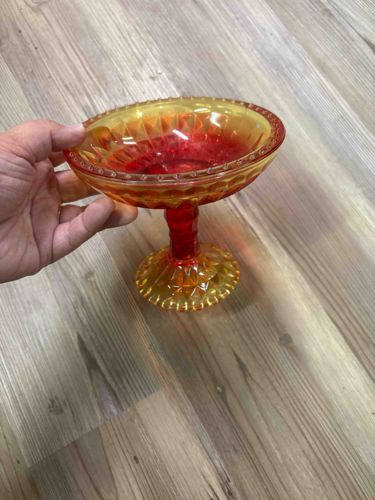
This item is a decorative compote dish crafted from pressed glass, exhibiting a striking two-tone color scheme. The bowl and the base of the dish are primarily a vibrant marigold or amber color, while the stem, and the interior of the bowl gradually transition into a rich ruby red. The glass appears translucent and shifts in color intensity, with the red being more prominent at the center of the bowl and throughout the stem, and the marigold dominating the outer rim of the bowl and the expanded foot. The compote features a clear, geometric pattern throughout, likely indicating it was produced using a mold. The bowl showcases a diamond-point or hobnail-like texture on its exterior and interior, lending it a faceted appearance that catches and refracts light. The rim of the bowl is also adorned with a repeating pattern of small, raised dots creating a scalloped or beaded edge. The stem is relatively short and thick, presenting a twisted or fluted design. The circular base mirrors the bowl's patterned texture, with similar diamond-point facets and a beaded edge. There are no visible chips, cracks, or significant damage, suggesting it is in good vintage condition. The surface exhibits a slight sheen, indicative of well-preserved glass with minimal wear. Without a clear view of the bottom or any discernible marks, precise manufacturing details or a specific maker are difficult to determine. However, the style and coloration are characteristic of depression glass or carnival glass from the early to mid-20th century. The quality appears good, typical of mass-produced decorative glassware of that era.
AI Appraisal Report
Upon visual examination of the provided image, I assess this two-tone marigold and ruby red pressed glass compote dish to be in good vintage condition. There are no readily apparent chips, cracks, or significant damage, and the surface retains a good sheen, suggesting minimal wear. The authenticity, based on its stylistic elements, coloration, and production method (pressed glass with geometric patterns), is consistent with decorative glassware from the early to mid-20th century, likely Depression-era or Carnival glass. However, without a physical inspection, I cannot verify the absence of subtle flaws like internal stress fractures or minute edge roughness. I also cannot definitively authenticate it to a specific manufacturer or pattern without seeing the base for marks or comparing it physically to known examples.
Market conditions for pressed glass of this type, while steady, do not generally reflect high values unless associated with a rare pattern, color combination, or a prestigious maker. This particular vibrant two-tone effect is attractive, and the hobnail/diamond-point texture adds visual interest, which contributes positively to its desirability. Demand for decorative vintage glassware remains, especially for eye-catching pieces. While unique in its color transition, pressed glass compotes are not exceedingly rare, and without a specific maker or pattern identification, it's considered a general vintage decorative item. Factors impacting value positively include its good condition and attractive coloration, while the lack of maker attribution and its common production method limit its upper value. A full authentication would require in-hand examination to check for maker's marks, assess glass quality and nuances, and compare it against known patterns or catalogs.