AI estimate as of October 2, 2025 · verify with a professional before acting
AI-Generated · Verify before acting
Everything on this page is generated by AI for informational purposes only. AI can make mistakes — the AI may misidentify items or misattribute them (artist, maker, brand, designer, origin, era). This is not an official valuation and should not be used for insurance, sale, tax, estate, legal, or lending purposes — or any decision requiring a certified appraisal. It is not an authoritative claim about any person, brand, or rights holder — do not share or rely on it as a factual statement about a third party. Always consult qualified professionals before making financial decisions.
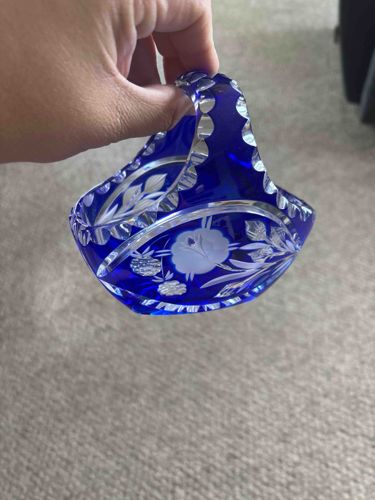
This exquisite item is a small decorative basket crafted from cobalt blue cut-to-clear crystal. The deep, vibrant blue glass is partially removed through a laborious cutting and etching process, revealing the clear crystal beneath and creating stunning frosted white designs. The basket features a gracefully arcing handle, which appears to be integral to the body, adorned with a scalloped edge that also shows the cut-to-clear technique. The main body of the basket is oval or semi-oval in shape, with a slightly fluted rim that is also heavily cut, exhibiting a series of angular facets. The primary decorative motif features floral elements, including a central large flower (possibly a rose or peony) with intricate petals, surrounded by various leaves, sprigs, and what appear to be smaller berry or fruit clusters. These designs are meticulously carved into the blue layer, resulting in a matte, frosted white finish that contrasts beautifully with the polished blue. The craftsmanship suggests a high level of skill, typical of lead crystal pieces from the mid-20th century or earlier. There are no visible chips, cracks, or significant condition issues from the provided image, indicating it has been well-preserved. The cut facets catch the light, enhancing its sparkling appearance. The quality indicators point to a handcrafted item, likely European, given the traditional cut crystal style. It would function as a decorative accent, a small trinket holder, or a candy dish.
AI Appraisal Report
Based on my visual examination of the provided image, this Cobalt Blue Cut-to-Clear Crystal Basket is a compelling piece of decorative glassware. The condition appears to be excellent; I did not observe any chips, cracks, or significant wear, which is crucial for cut crystal and indicative of careful preservation. The authenticity, while strongly suggested by the intricate craftsmanship and traditional styling, cannot be fully verified from an image alone. An in-person inspection would allow me to assess the weight, tactile quality of the cuts, and look for maker’s marks or signatures, which are often subtle or located on the underside. Provenance documentation, if available, would significantly enhance authentication.
This piece exhibits classic characteristics of mid-20th century European cut-to-clear crystal, possibly Bohemian or German. The deep cobalt blue contrasting with the frosted white floral and foliate motifs is a highly desirable aesthetic. The integral, arcing handle with its scalloped, cut-to-clear edge, along with the heavily faceted fluted rim, speaks to a high level of artisanal skill. Market conditions for quality vintage cut-to-clear crystal are steady, with a consistent demand from collectors of decorative glass. While not exceedingly rare, pieces in such excellent condition and with appealing designs like this one command respectable prices. The detailed floral etching, particularly the prominent central flower, adds to its decorative appeal and sets it apart from more generic patterns.
Factors impacting its value include the superb condition, the labor-intensive cut-to-clear technique, the attractive color and design, and the apparent quality of the lead crystal. Slight limitations in value assessment stem from the inability to confirm the maker, exact origin, or lead content without physical examination, which could potentially push the value higher if attributed to a renowned manufacturer. However, even as an unmarked piece of high quality, its decorative appeal and condition provide a solid basis for the estimated range.