These notes were written by the person who submitted this item. Appraiser.AI has not verified them, and the AI's identification and estimate may rely on them.
AI Estimated Value
Not an official valuation
$150-300
AI estimate as of July 10, 2025 · verify with a professional before acting
AI-Generated · Verify before acting
Everything on this page is generated by AI for informational purposes only. AI can make mistakes — the AI may misidentify items or misattribute them (artist, maker, brand, designer, origin, era). This is not an official valuation and should not be used for insurance, sale, tax, estate, legal, or lending purposes — or any decision requiring a certified appraisal. It is not an authoritative claim about any person, brand, or rights holder — do not share or rely on it as a factual statement about a third party. Always consult qualified professionals before making financial decisions.
This analysis also relies on unverified notes provided by the user, which may be incomplete or inaccurate and could affect the result.
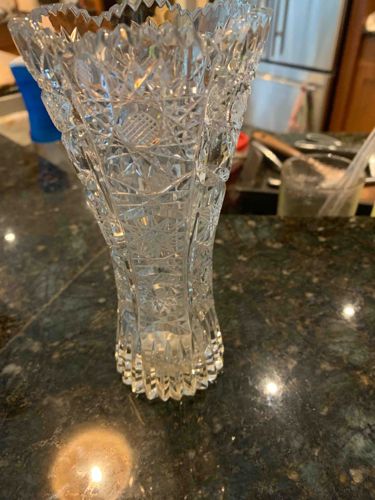
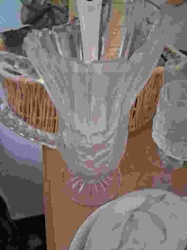
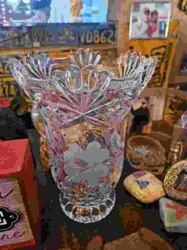
This is a clear, colorless crystal vase, likely dating from the early to mid-20th century, possibly in the American Brilliant Cut Glass style or a similar heavily cut pattern. The vase features intricate cut glass patterns across its entire body, including starbursts, cross-hatching, and fan cuts, indicative of high-quality craftsmanship. The rim is scalloped and serrated with sharp, pointed facets, adding to its decorative appeal. The body of the vase tapers slightly from a wider, flared opening to a narrower base, which is also heavily cut with radiating patterns and a scalloped edge, providing stability. The highly refractive nature of the crystal gives it a brilliant sparkle, characteristic of leaded glass. No obvious chips, cracks, or repairs are visible from the provided images, suggesting it is in good to excellent condition for its age. There might be minor surface scratches consistent with normal use and age, but these aren't clearly discernible. No distinct maker's marks or signatures are visible, which is common for many pieces of this period. The overall quality and complexity of the cutting indicate it was a finely made piece, designed for aesthetic display.
AI Appraisal Report
Upon examination of the provided images, this cut crystal vase presents as a fine example of early to mid-20th century craftsmanship, likely in the American Brilliant Period style or a high-quality reproduction thereof. The piece exhibits intricate and deeply cut patterns, including starbursts, cross-hatching, and fan motifs, which cover its entire surface from the scalloped, serrated rim to the stable, cut base. The high refractive quality suggests a significant lead content, characteristic of premium crystal from this era. Visually, the vase appears to be in excellent condition, with no discernible chips, cracks, or significant abrasions, which is a primary driver of its value. The absence of a visible maker's mark is common for this period but complicates definitive attribution to a specific manufacturer like Libbey, Pairpoint, or Dorflinger without further evidence.
The current market for American Brilliant Cut Glass has softened from its peak but remains steady for high-quality, undamaged pieces. Comparable vases of similar size, complexity, and condition without a known maker typically sell in the $150 to $300 range at auction and in retail settings. While the cutting is elaborate, its value is tempered by the lack of a signature, which would significantly increase its worth.
It is crucial to note that this appraisal is based solely on visual inspection of images. A full authentication would require physical examination to assess the weight and feel of the crystal, check for the 'ring' of leaded glass, use a blacklight to look for signs of modern adhesives or repairs, and meticulously search for faint acid-etched signatures that are often difficult to capture photographically. Without this in-person verification, the attribution and value remain provisional.