AI estimate as of November 3, 2025 · verify with a professional before acting
AI-Generated · Verify before acting
Everything on this page is generated by AI for informational purposes only. AI can make mistakes — the AI may misidentify items or misattribute them (artist, maker, brand, designer, origin, era). This is not an official valuation and should not be used for insurance, sale, tax, estate, legal, or lending purposes — or any decision requiring a certified appraisal. It is not an authoritative claim about any person, brand, or rights holder — do not share or rely on it as a factual statement about a third party. Always consult qualified professionals before making financial decisions.
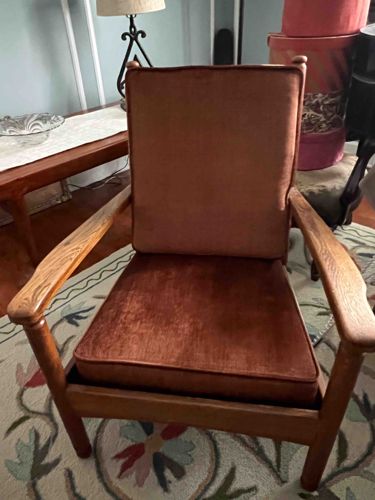
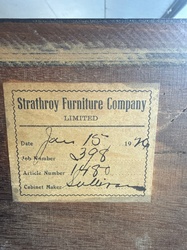
This is a vintage armchair, likely from the Arts and Crafts period or a later revival, characterized by its sturdy and unornamented wooden construction. The frame appears to be made of solid oak, exhibiting a rich, medium-brown finish with visible wood grain, suggesting a natural or lightly stained treatment. The chair features broad, flat armrests with a slight ergonomic curve, tapering towards the front. The legs are straight and square, possibly joined with mortise and tenon or similar robust joinery, typical of the Arts and Crafts movement's emphasis on craftsmanship and structural integrity. The backrest is composed of two vertical wooden stiles, supporting a removable back cushion. The seat also features a removable cushion. Both cushions are upholstered in a reddish-brown or rust-colored velvet-like fabric, showing some signs of wear and crushing consistent with age and use, particularly on the seat cushion. The fabric has a visible pile and a subtle sheen. The cushions are piped along their edges, adding a tailored finish. No specific maker's marks or signatures are discernible from the provided images. The overall condition suggests a well-used but structurally sound piece; there are no clear indications of significant damage, repairs, or breaks, though the wood finish may have minor scuffs or areas of thinning from age. The design is indicative of a focus on comfort and durability over elaborate decoration, aligning with the principles of early 20th-century design reformers. The presence of some scuffs on the wooden frame would be expected for an item of this presumed age.
AI Appraisal Report
This vintage armchair, likely from the Arts and Crafts period or a later revival, presents as a well-preserved example of its style. Based on my visual examination, the solid oak construction, broad flat armrests, and robust joinery (implied by the square legs and overall construction) align well with Arts and Crafts design principles emphasizing craftsmanship and durability over ornamentation. The medium-brown finish with visible wood grain further supports this aesthetic. The condition appears structurally sound, with no visible signs of significant damage, repairs, or breaks. Expected wear, such as minor scuffs on the wooden frame and crushing/wear on the reddish-brown velvet-like upholstery, is consistent with its presumed age and use.
Market conditions for Arts and Crafts furniture remain steady, though not as frenzied as in past decades. Pieces by un-attributed makers, while still appreciated for their quality and design, typically fetch lower prices than those by renowned designers like Gustav Stickley or Charles Rennie Mackintosh. This chair, lacking specific maker's marks, falls into the former category. Its general appeal, comfort, and the enduring popularity of the Arts and Crafts aesthetic create a moderate demand. However, the lack of rarity due to the commonality of similar forms prevents a higher valuation.
The primary factor impacting value is the lack of a known maker, which prevents it from reaching premium prices seen for authenticated designer pieces. The integrity of the frame is a strong positive. For full authentication and a more precise value, an in-person examination would be crucial to assess joinery details, wood species definitively, and the extent of wear and any professional restorations. Documentation of provenance would be ideal but is often unavailable for such pieces. Scientific testing is not typically required unless there's a strong belief it's a significant, attributed piece under dispute.