AI Appraisal Estimate

AI-generated estimates · not official valuations

From the user

What was submitted

Photo and notes provided by the user — not generated by AI

Submitted item photo
Submitted photo · June 4, 2026

User's notes

Calder

AI analysis below

AI appraisal

AI analysis & estimate

AI-Generated · Verify before acting

Everything below is generated by AI for informational purposes only. AI can make mistakes — the AI may misidentify items or misattribute them (artist, maker, brand, designer, origin, era). This is not an official valuation and should not be used for insurance, sale, tax, estate, legal, or lending purposes — or any decision requiring a certified appraisal. It is not an authoritative claim about any person, brand, or rights holder — do not share or rely on it as a factual statement about a third party. Always consult qualified professionals before making financial decisions.

Note

This analysis also relies on unverified notes provided by the user, which may be incomplete or inaccurate and could affect the result.

Read the full disclaimer

AI Identification

·Not independently authenticated·Verify before acting

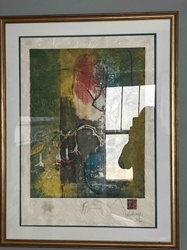
Alexander Calder 'Boutons' (Buttons) Color Lithograph

Fine Art Prints & Works on Paper

AI Estimated Value

·Not an official valuation·Verify before acting

$3,000 - $5,000

As of June 4, 2026

AI Item Analysis

·AI can make mistakes·Verify before acting
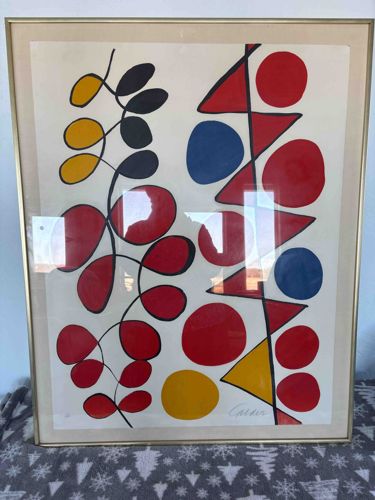
This is a mid-century modern color lithograph on paper attributed to Alexander Calder, a seminal figure in kinetic art and abstract sculpture. The composition features Calder’s signature primary color palette—vibrant reds, deep blues, and mustard yellows—balanced with bold black decorative linework. The work is physically structured around two vertical axes: on the left, a serpentine black line loops to form organic 'bulb' or petal shapes, some filled with red, yellow, and black; on the right, a jagged zigzag line supports various circles and triangles. The background is a natural off-white or cream-toned paper. A visible signature 'Calder' appears in the lower right corner, consistent with the artist’s known hand. The piece is housed in a simple, thin gold-toned metallic frame with a wide off-white mat. Regarding condition, there is several prominent horizontal reflections on the glass indicating it is not museum-quality non-glare glazing. The paper appears relatively flat, though the age of the framing suggests possible light-toning and mild acidity from the mat board. This style is characteristic of Calder’s graphic works from the 1960s to early 1970s, reflecting his background in mechanical engineering and fascination with playful, balanced geometric forms. The craftsmanship is evidenced by the clean saturation of the ink and the deliberate, fluid weight of the gestural lines.
AI Appraisal Report

·AI can make mistakes·Verify before acting
Based on my visual examination of this color lithograph, 'Boutons' (Buttons), I find it to be a stylistically consistent example of Alexander Calder's prolific graphic output from the late 1960s to early 1970s. The composition exhibits his quintessential primary palette and balanced, playful geometry. The signature in the lower right appears to be in his hand, and the saturation of the inks suggests a legitimate lithographic process rather than a digital reproduction. The condition appears fair to good; however, the presence of standard glass and likely non-archival matting presents a risk of acidity and light-toning that necessitates a conservation review. Market demand for Calder's lithographs remains robust due to his global recognition, though values are highly dependent on edition size and state. Comparable works from the 'Boutons' series frequently achieve between $3,000 and $5,500 at major auction houses like Sotheby's or Christie's, depending on the vibrancy of the paper and presence of an edition number. Limitations: This appraisal is based solely on photographic evidence. A definitive authentication requires a physical inspection to verify paper watermarks (such as Arches or Rives), the presence of an embossed publisher's stamp, and a formal provenance check. I strongly recommend removing the work from its current frame to inspect the margins for hidden damage or an edition number (e.g., 'EA' or '12/75'). A full authentication would involve matching this specific strike against the Maeght Editeur catalogs.

Get your items appraised

Instant estimates of your treasures with AI-powered appraisals

Browse More Appraisals