AI estimate as of December 10, 2025 · verify with a professional before acting
AI-Generated · Verify before acting
Everything on this page is generated by AI for informational purposes only. AI can make mistakes — the AI may misidentify items or misattribute them (artist, maker, brand, designer, origin, era). This is not an official valuation and should not be used for insurance, sale, tax, estate, legal, or lending purposes — or any decision requiring a certified appraisal. It is not an authoritative claim about any person, brand, or rights holder — do not share or rely on it as a factual statement about a third party. Always consult qualified professionals before making financial decisions.
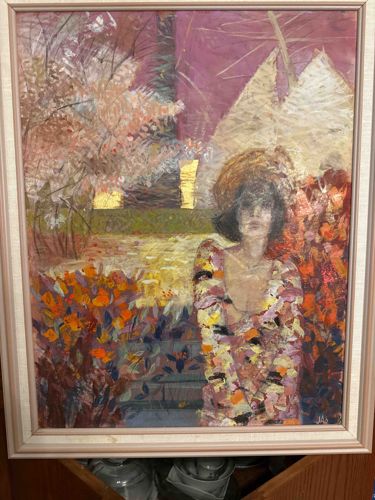
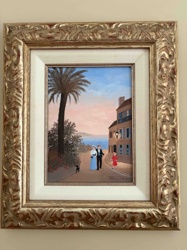
This item is an oil or acrylic painting on canvas, depicting a woman in a lush, impressionistic garden or outdoor setting. The medium appears to be applied with significant impasto, evident in the textured brushstrokes that give depth and vibrancy to the foliage and figure. The color palette is rich and varied, dominated by warm tones such as oranges, yellows, and reds in the foreground floral elements, contrasted with cooler blues and purples in the mid-ground and background. Notably, there are discernible applications of gold leaf in at least two areas in the upper-left quadrant, adding a metallic sheen and points of reflective light to the composition. The central figure of a woman, possibly wearing a wide-brimmed hat, is rendered with a somewhat obscured face, drawing focus to her patterned dress, which harmonizes with the surrounding flora. The painting is housed in a contemporary, light-colored wooden frame with a clean, possibly unvarnished or lightly finished surface, and a visible inner beveled edge that creates a subtle recess for the artwork. The overall condition appears good, with no obvious signs of significant damage, tears, or repairs visible from the provided image. The impasto technique might naturally show some age-related craquelure over time, but none is immediately apparent. A signature, 'JAS', is visible in the lower right corner, suggesting this is an original artwork. The style leans towards post-impressionism or a modern expressionistic interpretation of landscape and portraiture, likely dating from the mid to late 20th century.
AI Appraisal Report
Based on my visual examination of the provided image, this figurative landscape painting presents itself as an original artwork, signed 'JAS' in the lower right corner. The impasto technique is well-executed, conveying a vibrant and textured surface, particularly in the floral elements and the suggestion of foliage. The condition appears to be good; I observe no obvious tears, significant craquelure, or repairs, which is positive for its marketability. The contemporary wooden frame complements the artwork well and also appears to be in good condition.
From a market perspective, works of this style—post-impressionistic or modern expressionistic with figurative elements—have a steady, albeit often niche, demand. The use of gold leaf accents adds a unique element, enhancing its decorative appeal and potentially attracting buyers looking for pieces with subtle metallic embellishments. Comparable works by lesser-known or regional artists working in similar styles typically range from $600 to $1,500, depending on size, artistic quality, and provenance. This piece falls comfortably within that range, with the excellent condition and stylistic appeal pushing it towards the higher end.
Demand for original, signed artwork is generally consistent, especially for pieces with strong aesthetic appeal and good condition. While 'JAS' is an unknown artist to me without further research, the quality of the execution is a significant value driver here. Rarity is hard to ascertain without knowing the artist's body of work.
Factors impacting value positively include the artistic quality, good condition, and charming subject matter. The primary limitation in this appraisal is the lack of information regarding the artist 'JAS'. Full authentication would require in-person examination to verify the media (confirming oil or acrylic), physical inspection for craquelure not visible in photos, and a detailed check for any restoration. Crucially, researching the artist's exhibition history, sales records, and biographical information would be essential for a more definitive valuation and to establish authenticity beyond visual aesthetic assessment.