These notes were written by the person who submitted this item. Appraiser.AI has not verified them, and the AI's identification and estimate may rely on them.
AI Estimated Value
Not an official valuation
$100 - $200
AI estimate as of October 10, 2025 · verify with a professional before acting
AI-Generated · Verify before acting
Everything on this page is generated by AI for informational purposes only. AI can make mistakes — the AI may misidentify items or misattribute them (artist, maker, brand, designer, origin, era). This is not an official valuation and should not be used for insurance, sale, tax, estate, legal, or lending purposes — or any decision requiring a certified appraisal. It is not an authoritative claim about any person, brand, or rights holder — do not share or rely on it as a factual statement about a third party. Always consult qualified professionals before making financial decisions.
This analysis also relies on unverified notes provided by the user, which may be incomplete or inaccurate and could affect the result.
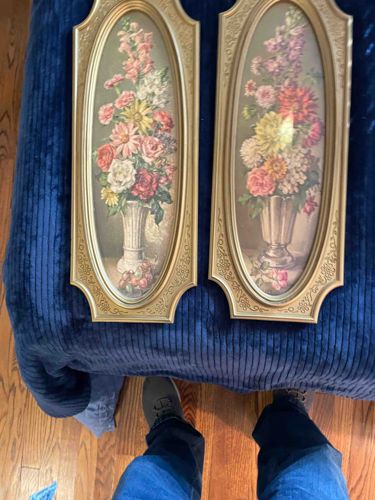
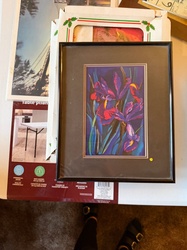
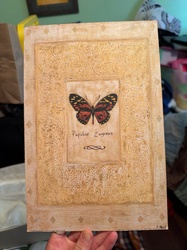
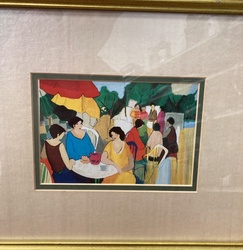
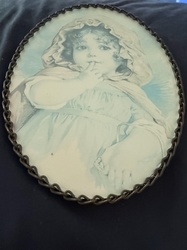
This is a pair of antique decorative prints featuring floral still life compositions, presented in matching ornate gold-colored frames. Each print depicts a vibrant bouquet of various flowers, including roses, snapdragons, dahlias, and other garden blossoms, arranged in a classical urn-shaped vase. The color palette primarily consists of soft pinks, reds, yellows, whites, and purples against a muted, greenish-brown background, suggesting a traditional aesthetic. The images appear to be lithographs or other forms of reproductive prints, showcasing a detailed, painterly quality. Each print is housed under glass within an oval-shaped opening set into a rectangular frame with scalloped edges at the top and bottom. The frames are likely made of a molded material, possibly wood or composite with a gesso and gilder's finish, or perhaps a resin, and are finished in a metallic gold color. They feature elaborate, raised decorative motifs, including scrolling patterns and floral or foliate designs, particularly along the inner and outer edges of the oval aperture. The condition of the pieces appears generally good for their age, with some visible wear consistent with antique items, such as potential minor scuffs or loss of gilding on the frames, and possibly slight discoloration or fading of the prints over time, though these are not clearly discernible in the provided image. There might be some dust accumulation under the glass. Their style suggests a period likely from the late 19th to early 20th century, appealing to prevalent tastes for decorative art during that era. The craftsmanship, while mass-produced for decorative appeal, shows attention to detail in the frame's molding. Their paired nature enhances their decorative value.
AI Appraisal Report
Upon examining the images of this pair of antique floral still life prints, I have determined an estimated fair market value. The items are decorative prints, likely color lithographs from the late 19th or early 20th century, designed for mass-market appeal. They are not original paintings. The prints feature traditional floral compositions and are housed in elaborate, matching gold-colored frames, which appear to be molded from gesso over wood or a composite material. The overall condition, based on the images, is good for their age, with the paired nature enhancing their decorative value.
The primary value driver for these pieces lies in their decorative quality rather than their rarity or artistic origin. The market for such decorative prints is generally stable but modest. Comparable pairs of antique floral lithographs in similar ornate frames typically sell in the range of $100 to $200 at auction or in antique shops. The ornate frames contribute significantly to their appeal and overall value.
My assessment is limited by the fact that I have not physically inspected the items. An in-person examination would be required to definitively identify the printing method (e.g., chromolithography, offset lithography), confirm the material of the frames, and more accurately assess the condition of the prints, including any fading or damage under the glass. Full authentication would involve de-framing one of the prints to look for publisher's marks, artist signatures, or other identifying information that is not currently visible.