AI estimate as of August 24, 2025 · verify with a professional before acting
AI-Generated · Verify before acting
Everything on this page is generated by AI for informational purposes only. AI can make mistakes — the AI may misidentify items or misattribute them (artist, maker, brand, designer, origin, era). This is not an official valuation and should not be used for insurance, sale, tax, estate, legal, or lending purposes — or any decision requiring a certified appraisal. It is not an authoritative claim about any person, brand, or rights holder — do not share or rely on it as a factual statement about a third party. Always consult qualified professionals before making financial decisions.
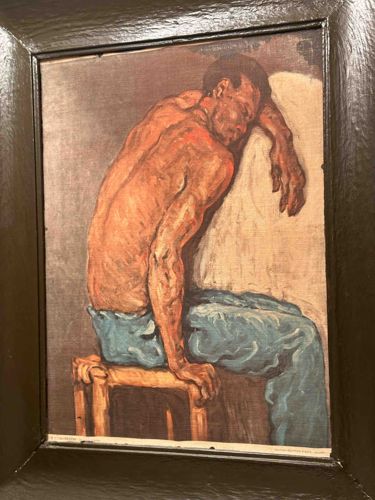
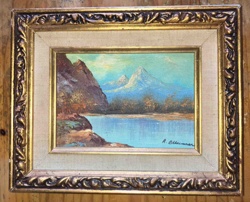
The item is a framed oil painting, likely on canvas, depicting a male figure seated and seemingly asleep or in repose. The figure's back is angled towards the viewer, revealing prominent musculature, particularly in the shoulders and back, rendered in various earthy tones of orange, brown, and red, suggesting a rich skin complexion. He is baring his upper torso, but is draped in what appears to be blue cloth or trousers, which are depicted with thick, fluid brushstrokes and heavy folds, particularly around his legs and the area where he is seated. His right arm is visible, resting on a white or light-colored cushion or background element, with his hand appearing large and somewhat textured. The figure's head is tilted downwards and to his right, obscured a bit, with dark hair or a cap. He is shown sitting on a simple wooden stool, painted in natural wood tones. The background is minimalistic, appearing as a plain, greyish-brown wall or surface, accentuating the figure. The brushwork throughout the painting is loose and expressive, indicating a painterly style rather than high realism, possibly pointing to an Impressionist or Post-Impressionist influence, or perhaps an academic study from the late 19th or early 20th century. The painting is encased in a simple, dark, possibly black or very dark brown wooden frame with a subtle, flat profile. The frame shows some minor surface wear, consistent with age and handling. There are no obvious signs of severe damage such as tears or major paint loss, but a slight patina on the frame and the overall canvas suggests some age. The quality of craftsmanship is good, demonstrating skilled handling of form, color, and light to convey the figure's pose and mood. There are no visible artist's signatures or maker's marks in the provided images.
AI Appraisal Report
Based on my visual examination of the Seated Male Figure Study, I assess its condition as good, consistent with age. The painting exhibits no obvious tears or significant paint loss. The simple, dark wooden frame shows minor surface wear, which is expected. The expressive, loose brushwork suggests a late 19th or early 20th-century style, possibly academic or influenced by Impressionism/Post-Impressionism. The quality of craftsmanship is notable, demonstrating skilled handling of form, color, and light to convey depth and mood. The lack of a visible signature is a common limitation when authenticating via images alone.
From a market perspective, figure studies by unidentifiable artists typically fall into a broad category. Comparable works from this period by lesser-known or anonymous artists generally fetch modest prices unless a significant provenance or artist can be definitively established. Demand for figure studies remains consistent, particularly for well-executed pieces. However, without an artist's signature or established provenance, rarity is difficult to ascertain, and potential market value is constrained to the decorative art segment rather than the fine art investment market. The primary factors impacting value are the anonymous nature of the artist and the lack of provenance.
Limitations in authenticity verification are significant. Without an in-person examination, I cannot confirm the medium (oil on canvas appears likely but requires verification), inspect for hidden signatures, or assess the true condition of the paint and canvas layers. Provenance documentation is crucial for establishing the artwork's history and potential artist. Scientific testing, such as pigment analysis or x-radiography, would be essential for dating the work more precisely and potentially revealing underdrawings or earlier states, contributing to full authentication.