AI estimate as of December 1, 2025 · verify with a professional before acting
AI-Generated · Verify before acting
Everything on this page is generated by AI for informational purposes only. AI can make mistakes — the AI may misidentify items or misattribute them (artist, maker, brand, designer, origin, era). This is not an official valuation and should not be used for insurance, sale, tax, estate, legal, or lending purposes — or any decision requiring a certified appraisal. It is not an authoritative claim about any person, brand, or rights holder — do not share or rely on it as a factual statement about a third party. Always consult qualified professionals before making financial decisions.
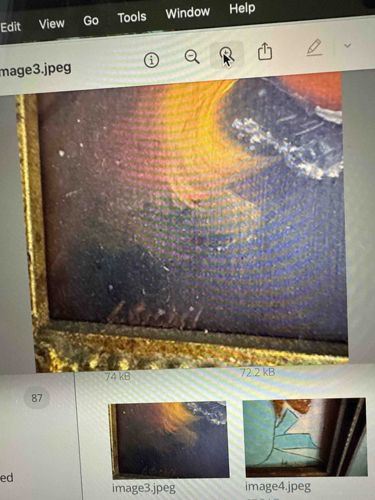
The item appears to be a fragment or detail of an oil or acrylic painting, framed within a decorative, possibly gilded, frame. The visible portion of the artwork features a vibrant and dynamic composition, characterized by broad, expressive brushstrokes. Bright yellows and oranges dominate the upper central area, suggesting a luminous element like a sun, flame, or abstract energy source. These warm tones transition into deeper reds, purples, and blues at the periphery and lower sections, creating a sense of depth and atmospheric effect. The textures are pronounced, indicating impasto techniques where paint is applied thickly, particularly noticeable in the lighter areas.
The painting is housed in a rectangular frame that exhibits a metallic, likely gilded, finish. The frame shows significant signs of age and wear, including chipping, tarnishing, and accumulated grime or dust, particularly visible in the crevices and along the inner edge where it meets the artwork. The overall impression of the frame is one of aged opulence, despite its current condition. At the very bottom edge of the visible painting, faint, possibly hand-written markings or a signature can be discerned, though they are too indistinct to read clearly. This suggests the inclusion of an artist's signature or other identifying mark. The style suggests an abstract, impressionistic, or possibly expressionistic approach, typical of 20th-century art, though a more precise age would require a clearer view of the signature or a full view of the artwork. The fragment captures a strong play of light and shadow, and the craftsmanship of the painting appears competent, with a clear artistic intention behind the color choices and brushwork. The visible condition issues include surface dust, potential minor abrasions on the paint surface, and the aforementioned significant wear on the frame.
AI Appraisal Report
Upon visual examination of this Abstract or Impressionistic Painting Fragment in Gilded Frame, I can ascertain that the artwork exhibits broad, expressive brushstrokes and a vibrant color palette dominated by warm yellows and oranges, transitioning to cooler reds, purples, and blues. The impasto technique used suggests a confident artistic hand. The style points towards a 20th-century abstract, impressionistic, or expressionistic approach. However, identifying the artist is difficult due to the artwork being a fragment and the indistinct, possibly handwritten, marks at the bottom edge. Authenticity cannot be definitively verified from the image alone without a clearer view of this potential signature or other identifying features. The painting itself appears to be in fair condition, with visible surface dust and potential minor abrasions. The gilded frame, while conveying a sense of aged opulence, shows significant wear, including chipping, tarnishing, and accumulated grime, which detracts from the overall presentation. The market for unsigned abstract fragments is generally limited. While the artistic quality seems competent, the lack of a clear artist identification and the fragmented nature of the piece significantly impact its value. Comparables would typically be entry-level abstract works by lesser-known or unidentified artists. The rarity of an unknown fragment is not a strong value driver unless it can be definitively linked to a major artist, which is not possible here. To accurately authenticate and place this piece, an in-person examination would be crucial to analyze the pigment, canvas, and to clearly identify any signature. Provenance documentation would also be essential for full authentication and to establish a more precise age and artist attribution.