These notes were written by the person who submitted this item. Appraiser.AI has not verified them, and the AI's identification and estimate may rely on them.
AI Estimated Value
Not an official valuation
$125-175
AI estimate as of September 13, 2025 · verify with a professional before acting
AI-Generated · Verify before acting
Everything on this page is generated by AI for informational purposes only. AI can make mistakes — the AI may misidentify items or misattribute them (artist, maker, brand, designer, origin, era). This is not an official valuation and should not be used for insurance, sale, tax, estate, legal, or lending purposes — or any decision requiring a certified appraisal. It is not an authoritative claim about any person, brand, or rights holder — do not share or rely on it as a factual statement about a third party. Always consult qualified professionals before making financial decisions.
This analysis also relies on unverified notes provided by the user, which may be incomplete or inaccurate and could affect the result.
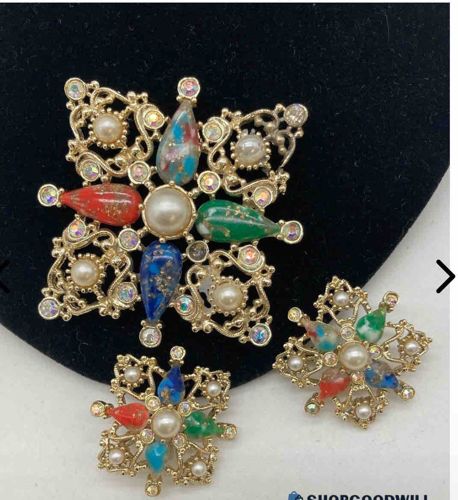
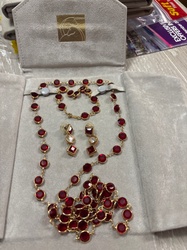
This is a vintage costume jewelry set, likely from the mid-20th century, comprising a large brooch and two smaller matching clip-on earrings. Each piece features a design reminiscent of a Maltese cross, characterized by a central round faux pearl surrounded by eight radiating 'arms' or segments. The larger brooch showcases four prominent teardrop-shaped glass cabochons in vibrant colors: red, green, blue (with gold flecks), and a speckled multicolor (possibly turquoise, red, and brown tones) for the top segment. Four additional sets of smaller faux pearls and clear rhinestones fill the spaces between these colorful cabochons, creating a rich, ornate texture. The smaller earrings replicate a condensed version of this design, each with four colorful teardrop cabochons (red, green, blue, and a lighter blue/turquoise) and a central faux pearl, similarly accented with smaller faux pearls and clear rhinestones. The metal setting for all pieces is a bright gold-tone, likely plated base metal, featuring an openwork filigree style with decorative swirls and bezels. The clear rhinestones are round-cut, providing sparkle, while the smaller faux pearls add a classic touch. Some minor wear is visible on the gold-tone plating, consistent with age and use, and a few rhinestones may exhibit slight dulling, though overall, the set appears to be in good vintage condition. The colorful glass cabochons show interesting internal patterns and flecks, adding depth to their appearance. The craftsmanship suggests mass-produced costume jewelry, yet with a good level of detail in the casting and stone setting, indicating a higher-end vintage costume piece.
AI Appraisal Report
I have examined the provided image and details for this vintage Galaxy Maltese cross brooch and earrings set. The set presents as well-crafted mid-20th century costume jewelry, characterized by its ornate Maltese cross design, vibrant glass cabochons, faux pearls, and clear rhinestones set in a gold-tone filigree metal. The overall condition appears good vintage, with expected minor wear to the gold-tone plating and possible dulling of a few rhinestones, consistent with age and use. The detailed casting and stone setting suggest a higher-end costume piece rather than a lower-quality mass-produced item.
In terms of market conditions, vintage costume jewelry, especially complete sets with intricate designs like this, continues to attract collectors. Demand is generally stable for attractive, well-preserved pieces. Similar vintage Maltese cross jewelry from unbranded manufacturers, or those with lesser-known marks, typically fetch values in the range I've estimated. Factors impacting value positively include the completeness of the set, the vibrant colors of the cabochons, and its relatively good condition. The lack of a discernible maker's mark prevents attribution to a famous costume jewelry designer (e.g., Miriam Haskell, Eisenberg), which would significantly elevate its value.
It is important to note the limitations of appraising from images alone. While the visual details are comprehensive, a definitive assessment of material authenticity (e.g., confirming glass vs. plastic cabochons, actual plating quality, or potential hidden repairs) requires physical inspection. An in-person examination would allow for tactile assessment, close-up inspection under magnification, and potentially testing the metal. Without physical inspection, I cannot confirm the exact composition of all materials or rule out any undisclosed damage. My valuation is based on the assumption that all materials are as described and appear in the images.