AI estimate as of October 16, 2025 · verify with a professional before acting
AI-Generated · Verify before acting
Everything on this page is generated by AI for informational purposes only. AI can make mistakes — the AI may misidentify items or misattribute them (artist, maker, brand, designer, origin, era). This is not an official valuation and should not be used for insurance, sale, tax, estate, legal, or lending purposes — or any decision requiring a certified appraisal. It is not an authoritative claim about any person, brand, or rights holder — do not share or rely on it as a factual statement about a third party. Always consult qualified professionals before making financial decisions.
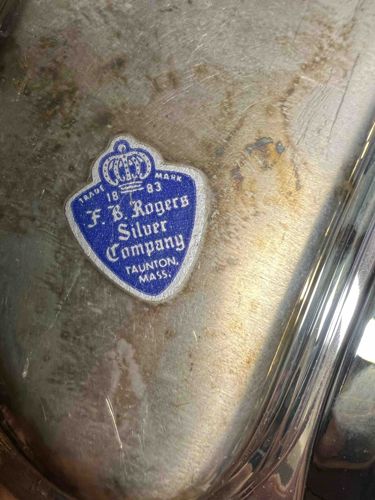
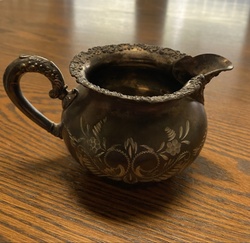
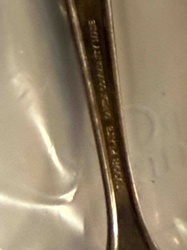
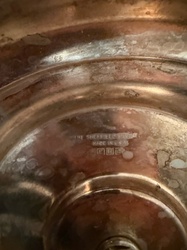
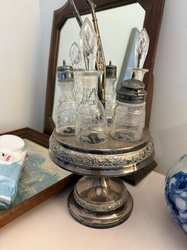
The item in the image appears to be a silver-plated platter or tray, evidenced by the reflective metallic surface and the presence of what seems to be a manufacturer's label. The label is a distinctive blue and white sticker, shaped like a shield or crest, featuring a crown motif at its top. Clearly visible text on the label reads "TRADE MARK 1883," "F. B. Rogers Silver Company," and "TAUNTON, MASS." This label indicates the item was manufactured by F. B. Rogers Silver Company, established in 1883 in Taunton, Massachusetts. The metallic surface exhibits significant signs of age and wear. There are numerous scratches, indicating repeated use and cleaning over time. Furthermore, localized areas of discoloration, including brown and greenish oxidation, are present, suggesting either tarnishing of the silver plating, or corrosion of the base metal where the plating may have worn thin. The surface also has a somewhat dull, mottled appearance in places, consistent with a tarnished silver finish rather than bright, polished silver. The edges of the item, visible on the right side of the image, show a slightly raised or rolled design, typical of serving platters or trays, suggesting a functional and decorative household item. The visible craftsmanship, despite the wear, points to a period when silver-plated items were common for formal dining or decorative display. The item is likely from the late 19th or early 20th century, given the company's founding date and the style of the label.
AI Appraisal Report
Based on my visual examination of the provided image, I assess this F. B. Rogers Silver Company platter or tray.
**Condition and Authenticity:** The item's authenticity as an F. B. Rogers Silver Company piece is strongly supported by the clearly visible original label, displaying 'TRADE MARK 1883,' 'F. B. Rogers Silver Company,' and 'TAUNTON, MASS.' This company was a prolific manufacturer of silver-plated goods. The condition is fair to poor for a silver-plated item. There is significant surface wear, including numerous scratches consistent with repeated use and cleaning. More critically, extensive tarnish, localized brown and green oxidation, and a dull, mottled appearance indicate significant degradation of the silver plating and/or corrosion of the base metal. This suggests the silver plating is heavily worn in areas, exposing the underlying metal.
**Market Conditions and Comparables:** F. B. Rogers silver-plated items are common in the vintage and antique market. While the company has a long history, their plated wares generally do not command high values unless they are exceptionally rare patterns, highly detailed, or in pristine condition. Comparables for similar tarnished and worn F. B. Rogers platters typically fall in the $20-$80 range on online marketplaces and at antique shops.
**Demand and Rarity:** Demand for common patterns of tarnished silver-plated items is generally low. The item is not rare; F. B. Rogers produced a vast quantity of such pieces. Its primary appeal would be to collectors of F. B. Rogers memorabilia or individuals seeking a decorative piece for a rustic aesthetic, or someone willing to undertake restoration.
**Factors Significantly Impacting Value:** The most significant negative impact on value is its poor condition, specifically the heavy wear to the silver plating and extensive tarnish/oxidation. While restoration is possible, it is often not economically viable for common silver-plated items. The intact original label offers some historical interest, but does not offset the condition.
**Limitations:** From images alone, I cannot definitively determine the exact base metal composition, the depth of the silver plating, or precisely how much plating remains without physical inspection. An in-person examination would allow me to assess the extent of pitting or deeply etched corrosion, which could be more severe than visually apparent, and confirm if any structural damage exists. Provenance documentation (e.g., original sales receipts) would provide a definitive chain of ownership but is generally not available or necessary for common silver plate. Scientific testing, such as XRF analysis, could confirm metal composition and plating thickness, but this is typically reserved for high-value items where authenticity or material composition is in question beyond what visual inspection provides.