AI Appraisal Estimate

AI-generated estimates · not official valuations

From the user

What was submitted

Photo and notes provided by the user — not generated by AI

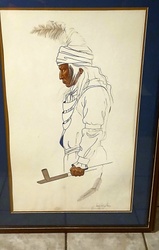
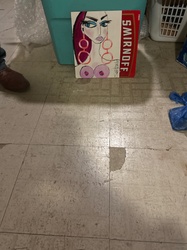
Submitted item photo
Submitted photo · June 3, 2026

User's notes

No additional notes provided.

AI analysis below

AI appraisal

AI analysis & estimate

AI-Generated · Verify before acting

Everything below is generated by AI for informational purposes only. AI can make mistakes — the AI may misidentify items or misattribute them (artist, maker, brand, designer, origin, era). This is not an official valuation and should not be used for insurance, sale, tax, estate, legal, or lending purposes — or any decision requiring a certified appraisal. It is not an authoritative claim about any person, brand, or rights holder — do not share or rely on it as a factual statement about a third party. Always consult qualified professionals before making financial decisions.

Read the full disclaimer

AI Identification

·Not independently authenticated·Verify before acting

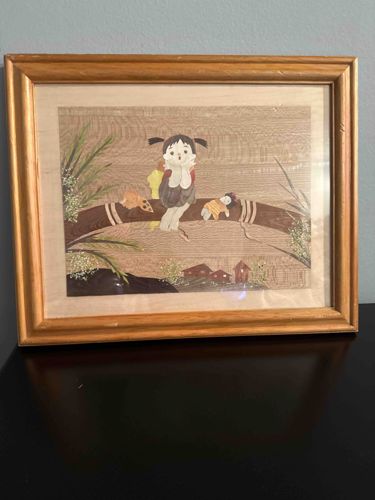
Vintage Japanese Wood Veneer Marquetry Art (Yosegi-zaiku style)

Folk Art / Mixed Media Artwork

AI Estimated Value

·Not an official valuation·Verify before acting

$150 - $250

As of June 3, 2026

AI Item Analysis

·AI can make mistakes·Verify before acting
This is a vintage framed artwork created through the intricate technique of wood veneer marquetry or 'wood skin' art, likely of Japanese origin. The piece depicts a whimsical scene featuring a young girl with pigtails sitting on a curved branch, flanked by small toys or dolls, with a rustic landscape of houses and foliage in the lower foreground. The construction utilizes various species and grains of natural wood veneers to create color and texture gradients; the background features a horizontal wood grain that mimics a sky or wall, while the branch and ground use darker, more textured burls. Notable details include the use of very thin, delicate wood shavings for the green foliage and white blossoms, demonstrating high craftsmanship typically found in the Showa era (mid-20th century). The piece is housed in a carved, light-stained wooden frame with a subtle gold-tone inner lip. Regarding condition, the frame shows visible nicks, scuffs, and minor finish loss consistent with age. There is slight lifting or rippling visible in the veneer background near the top right, and potential light fading from sun exposure. No distinct signature is visible in this view, but the style is highly characteristic of Japanese woodcraft exported between 1950 and 1970.
AI Appraisal Report

·AI can make mistakes·Verify before acting
Based on my visual examination of this vintage Japanese wood veneer marquetry piece, I have assessed it as a mid-20th-century decorative work, likely produced during the Showa era for the export market. The craftsmanship utilizes the 'Zogan' or 'Yosegi' style, employing natural wood grains to achieve depth and narrative without the use of pigments. The whimsical subject matter and specific veneer application—particularly the delicate use of shavings for foliage—are hallmarks of mid-century Japanese handicraft. Regarding condition, I noted visible wear to the frame including finish loss, and more critically, evidence of lifting and light atmospheric rippling in the background veneer. Such issues are common due to the archival properties of the adhesives used during this period, but they do negatively impact the value compared to a pristine example. The market for mid-century Japanese folk art remains steady but specialized; comparable pieces of this size and complexity typically realize moderate prices at boutique auctions or through vintage decor dealers. The lack of a visible signature suggests it may be a product of a regional workshop rather than a master artist. This appraisal is based solely on digital images. A definitive valuation would require a physical inspection to check for hidden structural damage, confirm wood species through microscopic analysis, and verify if a signature or export stamp is present on the reverse. Provenance documentation or a label from a known workshop (such as those in Hakone) would significantly enhance its marketability. Without physical verification, this evaluation assumes the veneers are natural wood and not a photographic or synthetic substitute.

Get your items appraised

Instant estimates of your treasures with AI-powered appraisals

Browse More Appraisals