AI estimate as of December 9, 2025 · verify with a professional before acting
AI-Generated · Verify before acting
Everything on this page is generated by AI for informational purposes only. AI can make mistakes — the AI may misidentify items or misattribute them (artist, maker, brand, designer, origin, era). This is not an official valuation and should not be used for insurance, sale, tax, estate, legal, or lending purposes — or any decision requiring a certified appraisal. It is not an authoritative claim about any person, brand, or rights holder — do not share or rely on it as a factual statement about a third party. Always consult qualified professionals before making financial decisions.
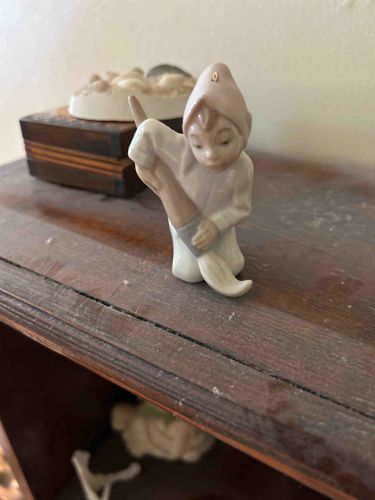
This appears to be a small porcelain figurine depicting a gnome or elf engaged in sweeping with a broom. The figure is crafted from what looks like glazed porcelain or bisque, characterized by its smooth, matte finish, primarily in soft, muted tones. The dominant colors are a light, creamy off-white for the main body of the attire and the broom bristles, and a pale, possibly lavender-grey or light brown for the pointed cap and the handle of the broom. The facial features are delicately rendered, suggesting a youthful appearance with subtle depressions for eyes and a small, understated nose and mouth. The figure is posed in a kneeling or crouching position, holding the broom in front of it as if in the act of sweeping. The construction seems solid, with no visible seams indicating multiple joined pieces, though this cannot be confirmed from the image. One notable feature is a small, elongated loop or ring, possibly part of a hanger or an identifying mark, on the very tip of the pointed cap. The general aesthetic points towards a collectible decorative item, possibly from the mid to late 20th century, given its style. There are no obvious signs of significant damage such as chips, cracks, or repairs visible from the provided images, indicating it is in relatively good condition, although a closer inspection would be required to confirm this. The craftsmanship appears to be fine, with smooth edges and consistent coloring, typical of mass-produced yet quality porcelain figurines.
AI Appraisal Report
Based on my visual examination of the provided image, this porcelain figurine, depicting a gnome or elf sweeping, appears to be in relatively good condition. I observe no obvious chips, cracks, or repairs, and the finish, whether glazed porcelain or bisque, seems uniform and well-preserved. The delicate rendering of facial features and consistent coloring suggest a quality-controlled manufacturing process. The small loop on the cap might indicate it was designed as an ornament or for hanging, common in decorative collectibles. Authenticity, based solely on an image, is difficult to ascertain fully. However, the style and apparent construction are consistent with mass-produced decorative figurines from the mid to late 20th century.
Market conditions for such decorative porcelain figurines are generally modest. While charming, these items are quite common. Comparables in the secondary market, often found in antique malls, online marketplaces, or estate sales, typically retail in the $15-$50 range, depending on precise maker, age, and condition. There is no indication from the image that this piece is from a historically significant or highly sought-after manufacturer, which would significantly increase its value. Demand for generic gnome/elf figurines is moderate at best; they are not considered rare.
Factors impacting value include its good condition and pleasant aesthetic. However, the lack of a prominent maker's mark (not visible in the image), and the general prevalence of similar items, temper its value. For a full authentication and to ascertain a more precise value, an in-person examination would be critical to check for any hidden damage, confirm the material (porcelain vs. bisque vs. a composite), identify any maker’s marks, and assess the overall quality and uniqueness more thoroughly. Provenance documentation, such as original purchase receipts or packaging, would also be beneficial but is unlikely for this type of item.