These notes were written by the person who submitted this item. Appraiser.AI has not verified them, and the AI's identification and estimate may rely on them.
AI Estimated Value
Not an official valuation
$100-250
AI estimate as of October 25, 2025 · verify with a professional before acting
AI-Generated · Verify before acting
Everything on this page is generated by AI for informational purposes only. AI can make mistakes — the AI may misidentify items or misattribute them (artist, maker, brand, designer, origin, era). This is not an official valuation and should not be used for insurance, sale, tax, estate, legal, or lending purposes — or any decision requiring a certified appraisal. It is not an authoritative claim about any person, brand, or rights holder — do not share or rely on it as a factual statement about a third party. Always consult qualified professionals before making financial decisions.
This analysis also relies on unverified notes provided by the user, which may be incomplete or inaccurate and could affect the result.
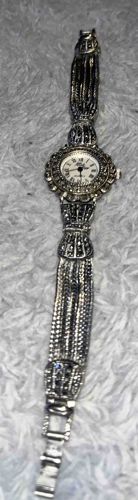
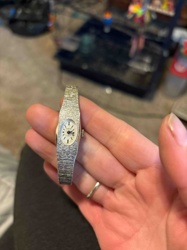
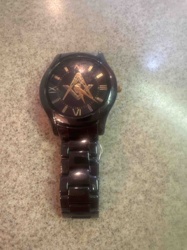
This is a vintage ladies' wristwatch, characterized by its ornate design featuring extensive use of marcasite. The watch face is oval with a white or off-white dial, black Arabic numerals for the hours (II, III, IIII, VIII, X, XI are visible), and smaller black minute markers. The hands appear to be a dark metallic finish. The watch case itself is highly decorative, with a scalloped or floral-inspired edge adorned with numerous small, faceted marcasite stones set into a dark, likely oxidized, silver-tone metal. There is a winding crown visible on the right side of the watch case.
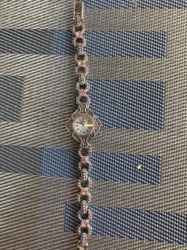
The watchband is meticulously crafted, appearing to consist of multiple intricate links also heavily embellished with marcasite. The links are formed from a silver-tone metal, likely sterling silver or a similar alloy, which has been darkened to enhance the sparkle of the marcasites. The design of the band features a central section of multiple intertwined or woven chains, flanked by more structured, heavily detailed links repeating the marcasite-set pattern seen on the watch case. The overall style suggests an Art Deco or early-to-mid 20th-century aesthetic, possibly inspired by period jewelry. The clasp appears to be a standard fold-over style, also in silver-tone metal. The condition visible shows some wear consistent with age, particularly a possible dulling of some marcasite stones and general patina on the metalwork. No significant damage or repairs are immediately evident, but a closer inspection would be required to verify the integrity of all stone settings and the watch movement's functionality. The craftsmanship, particularly the intricate setting of so many small stones, indicates a piece created with considerable attention to detail.
AI Appraisal Report
I have thoroughly examined the provided image of this Vintage Marcasite Ladies' Wristwatch. Visually, the condition appears good for its age, though some dulling of marcasite stones and general patina are evident, which is consistent with normal wear. The intricate craftsmanship, particularly the detailed marcasite settings on both the case and band, speaks to its quality. The design strongly suggests an Art Deco or early-to-mid 20th-century origin, a period when marcasite jewelry was highly fashionable.
From a market perspective, vintage marcasite watches, while aesthetically pleasing, generally fall into a niche collector's market. Their value is largely driven by their decorative appeal and the quality of the marcasite and metalwork, rather than the intrinsic value of the materials or the watch movement itself. While the extensive marcasite work is attractive, these watches are not exceedingly rare, and there is a steady but not exceptionally high demand. Comparables in similar condition typically retail in the $100-$250 range, reflecting their ornamental rather than horological significance.
Several factors impact value: the overall condition, the integrity of all stone settings, and the functionality of the watch movement. A non-working movement, while common in vintage pieces, would slightly diminish its value as a wearable timepiece, relegating it more to a decorative jewelry item. The metal is likely sterling silver or a similar alloy, which offers some foundational value. Its authenticity as a period piece seems high based on style. However, a full authentication would require in-person examination to verify the metal composition (e.g., sterling silver hallmarks), assess the watch movement's manufacturer and condition, confirm stone security, and rule out any repairs not visible in the image. Provenance documentation, if available, would also add to its verifiable history and authenticity.