These notes were written by the person who submitted this item. Appraiser.AI has not verified them, and the AI's identification and estimate may rely on them.
AI Estimated Value
Not an official valuation
$45 - $75
AI estimate as of September 6, 2025 · verify with a professional before acting
AI-Generated · Verify before acting
Everything on this page is generated by AI for informational purposes only. AI can make mistakes — the AI may misidentify items or misattribute them (artist, maker, brand, designer, origin, era). This is not an official valuation and should not be used for insurance, sale, tax, estate, legal, or lending purposes — or any decision requiring a certified appraisal. It is not an authoritative claim about any person, brand, or rights holder — do not share or rely on it as a factual statement about a third party. Always consult qualified professionals before making financial decisions.
This analysis also relies on unverified notes provided by the user, which may be incomplete or inaccurate and could affect the result.
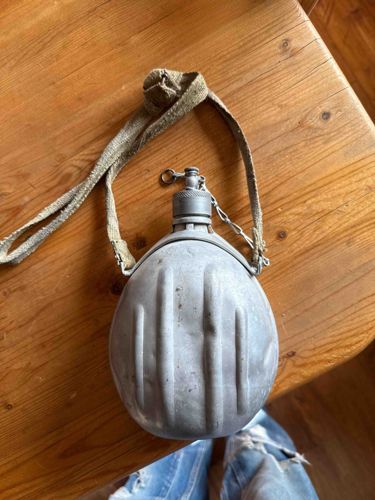
This item is identified as a WWI-era German military canteen, also known as a Feldflasche. It features a flattened, oblong, or kidney-shaped body constructed from what appears to be aluminum, indicative of later war production or a specific variant. The canteen has a roughly vertical ribbed pattern on its surface, likely for structural rigidity and perhaps better grip, with approximately seven or eight prominent vertical depressions. The primary color is a dull, unpolished metallic grey, showing significant signs of wear and age, including scratches, scuffs, and possibly some minor dents, contributing to a visible patina. The neck of the canteen is threaded for a screw-on cap, which is present and appears to be made of the same metal. A small metal chain connects the cap to a loop on the canteen's neck, preventing loss. Attached to the canteen are two attachment points for a carrying strap. The strap itself is made from a coarse, possibly canvas or linen, woven fabric in a drab olive or khaki color, consistent with military webbing of the period. The strap shows considerable fraying, discoloration, and wear, particularly where it has been knotted or secured, suggesting extensive use. There are no immediately visible maker's marks, stamps, or significant distinguishing features beyond its utilitarian military design. The overall condition suggests authenticity and age, typical of a field-used item from the early 20th century. Its construction and material point towards a robust design for military field use, and the visible wear indicates it served its intended purpose.
AI Appraisal Report
Upon examining the images of this German military canteen, or Feldflasche, I assess it to be an authentic example from the World War I period, likely a Model 1915 (M15) or later variant, based on its aluminum construction. The ribbed aluminum body, screw cap, and retention chain are all consistent with designs from this era. The canteen exhibits significant field use, evidenced by the extensive patina, scratches, and minor dents. The canvas or linen carrying strap, while showing considerable fraying and wear, appears original to the period and adds to its character as a combat-used artifact.
The market for common WWI German field gear is relatively stable. Canteens like this are not exceptionally rare, as they were mass-produced. The value is primarily determined by condition and completeness. This example is complete with its cap, chain, and strap, which is a positive factor. However, the visible wear and lack of a visible maker's mark or unit markings place it in the lower to mid-range of market value. Comparable sales for similar M15 aluminum canteens in this condition typically fall within the $45 to $75 range. Items with felt covers, cups, or clear manufacturer stamps (e.g., 'ESB', 'RFI') often fetch higher prices.
It is crucial to note the limitations of an appraisal based solely on images. Without a physical inspection, I cannot definitively confirm the material as aluminum versus tinned steel, nor can I search for subtle maker's marks or stamps that might be hidden by grime or wear. A hands-on examination would be required to fully authenticate the item and its components. Nonetheless, based on the visual evidence, the piece presents as a genuine and representative example of a WWI German Feldflasche.