AI estimate as of September 27, 2025 · verify with a professional before acting
AI-Generated · Verify before acting
Everything on this page is generated by AI for informational purposes only. AI can make mistakes — the AI may misidentify items or misattribute them (artist, maker, brand, designer, origin, era). This is not an official valuation and should not be used for insurance, sale, tax, estate, legal, or lending purposes — or any decision requiring a certified appraisal. It is not an authoritative claim about any person, brand, or rights holder — do not share or rely on it as a factual statement about a third party. Always consult qualified professionals before making financial decisions.
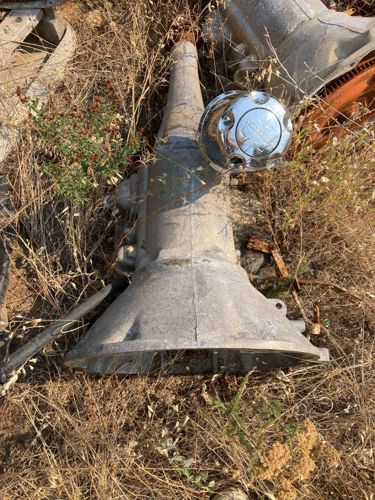
The item depicted is an automatic transmission case, likely cast from aluminum or a similar light alloy, featuring an integrated bellhousing. This component is essential for housing the internal gears and mechanisms of an automatic transmission and connecting it to the engine. Its physical characteristics include a substantial, somewhat conical bellhousing section designed to mate with an engine block, transitioning into a narrower, elongated tail shaft housing. The material appears to be a dull grey metal, indicative of aged and unpolished cast aluminum, possibly with some surface oxidization or grime from prolonged outdoor exposure. Visible condition issues include significant surface pitting and dirt accumulation, suggesting it has been stored outdoors or in a non-climate-controlled environment for an extended period. The overall surface texture is rough, consistent with a sand-cast part. There are no obvious signs of catastrophic damage such as large cracks or breaks, but detailed inspection for smaller damage, wear on mounting points, or internal corrosion would be necessary for a full assessment. One notable feature is an automotive wheel center cap, chrome-plated, with a stylized 'M' or similar emblem, loosely placed on top of the transmission case. This center cap is not part of the transmission but is resting on it. Without discernible manufacturer's marks or part numbers on the visible surfaces, specific manufacturing details or a precise age are difficult to determine, though the design suggests it could belong to an older American vehicle, possibly from the 1970s to 1990s era, given the overall casting appearance. The quality indicators point to a robust, utilitarian automotive component, designed for function over aesthetics, now showing signs of neglect.
AI Appraisal Report
Based on my visual examination of the provided image, the item is an automatic transmission case with an integrated bellhousing, likely cast from aluminum. Its condition appears fair to poor, displaying significant surface pitting, dirt accumulation, and what appears to be minor oxidation. The rough surface texture is consistent with a sand-cast automotive component, suggesting an older model. I see no obvious major structural damage like large cracks, which is positive, but the overall neglect indicates it has been stored in a non-climate-controlled environment. The chrome wheel center cap resting on top is not part of the item and holds no relevance to its value.
Authenticity of the specific make/model is difficult to determine without visible part numbers or manufacturer's marks. However, the general design suggests a unit from a domestic American vehicle, potentially from the 1970s-1990s.
Market conditions for used automatic transmission cases can vary widely depending on the specific application (make, model, year) and demand. Universal or readily available cases typically have low value, often sought by hobbyists for specific projects or as cores for remanufacturing. The visible condition issues significantly depress its value. Factors impacting value negatively include the extensive surface wear and the unknown internal condition. Without an in-person examination, I cannot assess internal wear, bearing races, or critical mounting surface integrity, which could render it unusable without extensive reconditioning.
For full authentication and a more precise valuation, I would require physical inspection to check for part numbers, original manufacturer markings, internal component wear, and structural integrity via non-destructive testing if necessary. Provenance documentation would also help pinpoint its exact application. Given its apparent condition and lack of specific identification, I appraise this automatic transmission case at a value of $50-$150. This range reflects its potential as a core or for a highly specific, low-budget project, assuming no critical hidden damage.