AI Appraisal Estimate

AI-generated estimates · not official valuations

From the user

What was submitted

Photo and notes provided by the user — not generated by AI

Submitted item photo
Submitted photo · May 27, 2026

User's notes

No additional notes provided.

AI analysis below

AI appraisal

AI analysis & estimate

AI-Generated · Verify before acting

Everything below is generated by AI for informational purposes only. AI can make mistakes — the AI may misidentify items or misattribute them (artist, maker, brand, designer, origin, era). This is not an official valuation and should not be used for insurance, sale, tax, estate, legal, or lending purposes — or any decision requiring a certified appraisal. It is not an authoritative claim about any person, brand, or rights holder — do not share or rely on it as a factual statement about a third party. Always consult qualified professionals before making financial decisions.

Read the full disclaimer

AI Identification

·Not independently authenticated·Verify before acting

Tavern Scene Genre Painting in Ornate Gilt Frame

Fine Art - Paintings

AI Estimated Value

·Not an official valuation·Verify before acting

$1,200 - $1,800

As of May 27, 2026

AI Item Analysis

·AI can make mistakes·Verify before acting
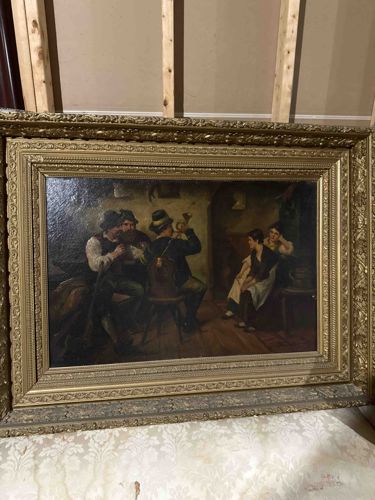
This is a large-scale oil on canvas painting depicting a classic European genre scene, likely of German or Austrian origin. The composition features a group of rustic figures in a dimly lit tavern or domestic interior; three men are gathered on the left, one playing a hunting horn, while two women observe from the right. The palette is dominated by earthy tones, ochres, and deep shadows, characteristic of 19th-century academic realism. The brushwork appears deliberate with a focus on capturing the textures of traditional alpine clothing and wooden furniture. The artwork is housed in a substantial, highly ornate multi-tiered gold-leaf or gilt-composition frame. The frame features several decorative bands, including a prominent egg-and-dart motif and a wide outer cove decorated with intricate acanthus leaf scrolling in high relief. Regarding condition, the canvas shows visible signs of age including surface grime and a yellowed varnish layer that has darkened the original colors. There is notable cracking (craquelure) consistent with seasonal expansion of a wooden stretcher bar over time. The frame shows some minor gesso loss and chipping, particularly at the corners and along the lower edge, revealing the white base material beneath the gold. While a specific signature is not immediately legible in this view, the style is strongly evocative of the Munich School of the late 1800s. The craftsmanship of both the frame and the figurative proportions suggests a professional artist of the Victorian era.


AI Appraisal Report

·AI can make mistakes·Verify before acting
Based on my visual examination of this oil on canvas genre scene, I observe a charming example of late 19th-century academic realism, likely originating from the German or Austrian Munich School tradition. The composition, depicting rustic figures in an interior tavern setting, is executed with a competent hand, particularly in the rendering of light and texture on the alpine clothing. The work is housed in a substantial period-appropriate gilt gesso frame with egg-and-dart molding and acanthus scrolling, which in itself holds significant decorative value ($300-$500 alone). However, the condition is a limiting factor; the dark, yellowed varnish suggests the painting has not been cleaned in decades, and the visible craquelure indicates stress on the canvas. The frame also exhibits typical age-related gesso losses. Market demand for anonymous or minor Victorian-era genre scenes has softened recently compared to the mid-20th century, though high-quality frames remain desirable for designers. Without a clearly legible signature or provenance, I must attribute this to 'Circle of' or ' Manner of' late 19th-century continental artists rather than a specific master. A full authentication would require physical inspection to test the varnish under UV light for overpainting and to decipher any signatures obscured by grime. Consequently, the value is derived primarily from its decorative appeal as a large-scale period piece. Should professional conservation reveal a noted signature, the value could increase significantly, but as it stands, it represents a solid decorative antique.

Get your items appraised

Instant estimates of your treasures with AI-powered appraisals

Browse More Appraisals