AI estimate as of October 8, 2025 · verify with a professional before acting
AI-Generated · Verify before acting
Everything on this page is generated by AI for informational purposes only. AI can make mistakes — the AI may misidentify items or misattribute them (artist, maker, brand, designer, origin, era). This is not an official valuation and should not be used for insurance, sale, tax, estate, legal, or lending purposes — or any decision requiring a certified appraisal. It is not an authoritative claim about any person, brand, or rights holder — do not share or rely on it as a factual statement about a third party. Always consult qualified professionals before making financial decisions.
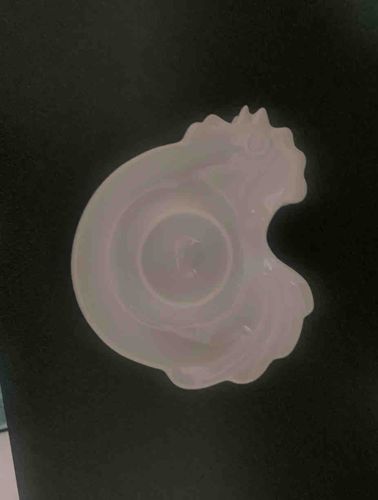
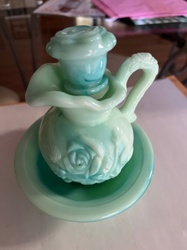
This item is an opalescent glass dish, likely intended as a candy dish or a small decorative holder, shaped in the form of a stylized chicken or rooster. The material appears to be a type of iridescent or opalescent glass, exhibiting a milky, translucent quality with subtle shifts in color, predominantly in shades of off-white, light pink, and faint blue, depending on the angle and lighting. The overall form is organic and somewhat abstract, with the upper portion clearly depicting the head and comb of a chicken, rendered with a series of gentle undulations and points. The body of the chicken forms the containment area, which is a circular depression with concentric rings, suggesting it was molded. The edges of the dish are irregularly shaped to conform to the chicken's silhouette, featuring softer, rounded curves along the bottom and more defined, wavy edges along the 'back' and 'comb' of the bird. There are no visible chips, cracks, or significant damage, suggesting it is in good, possibly unused, condition. The surface appears smooth and glossy to the touch. Due to the opalescent nature and the molded form, it likely dates from the early to mid-20th century, a popular period for this type of decorative glass. The craftsmanship, while factory-produced, demonstrates care in achieving the animal's recognizable form and the delicate iridescence of the glass. There are no discernible maker's marks or signatures visible from the provided image.
AI Appraisal Report
Based on my visual examination of the provided image, I assess this opalescent glass chicken candy dish/holder to be in excellent condition. There are no visible chips, cracks, or significant damage, and the surface appears smooth and glossy, indicative of careful preservation. The molded form and opalescent glass suggest an early to mid-20th-century production, a period when such decorative glassware was quite popular. This type of glass, often referred to as 'milk glass' with iridescent properties, is authentic to that era.
Market conditions for vintage opalescent glassware vary. While there is consistent demand among collectors of specific patterns or manufacturers, generic pieces like this stylized chicken tend to fetch more modest prices. Comparables for similar opalescent chicken or hen-on-nest dishes from unidentifiable manufacturers typically range from $40 to $150, depending heavily on condition, size, and particularly unique design elements. This piece has a charming, recognizable form which adds to its appeal. Its excellent condition is a significant positive factor. Rarity is not a primary value driver here, as many such items were mass-produced, though this specific rendition may be less common than others.
Factors impacting value include its appealing design, excellent condition, and its functional as well as decorative nature. The primary limitation in authenticating completely from an image is the inability to detect subtle imperceptible damage, true material composition (e.g., lead content), or any maker’s marks that might be on the base or obscured. For full authentication and a more precise valuation, I would require an in-person examination to check for internal flaws, measure actual dimensions, and thoroughly inspect for any hidden marks or repairs. Provenance documentation, if available, could also provide valuable context regarding its manufacturing origin and history.