AI estimate as of October 1, 2025 · verify with a professional before acting
AI-Generated · Verify before acting
Everything on this page is generated by AI for informational purposes only. AI can make mistakes — the AI may misidentify items or misattribute them (artist, maker, brand, designer, origin, era). This is not an official valuation and should not be used for insurance, sale, tax, estate, legal, or lending purposes — or any decision requiring a certified appraisal. It is not an authoritative claim about any person, brand, or rights holder — do not share or rely on it as a factual statement about a third party. Always consult qualified professionals before making financial decisions.
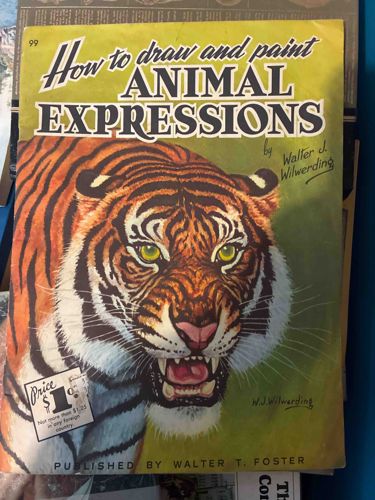
This item is a vintage art instruction book titled "How to draw and paint ANIMAL EXPRESSIONS." The cover features a vivid, realistic illustration of a tiger's head, snarling with its mouth open, showcasing its teeth and a pink tongue. The tiger's fur is depicted with characteristic orange, black, and white stripes, and its eyes are a striking yellow-green. The background is a solid olive-green color. The title is prominently displayed in a stylized, hand-drawn font, with "How to draw and paint" in script and "ANIMAL EXPRESSIONS" in large, outlined block letters. The author, Walter J. Wilwerding, is credited in script text on the upper right and also with a signature-style inscription on the lower right of the tiger illustration: "W. J. Wilwerding". The publisher, "PUBLISHED BY WALTER T. FOSTER," is printed along the bottom edge of the cover. A circular white sticker with a black border, marked "Price $1.00" and "Not more than $1.25 in any foreign country," is affixed to the lower-left corner of the tiger illustration. There's also a smaller number "99" in the top left corner, possibly an internal catalog number or series number. The book appears to be a softcover, with visible wear along the edges and corners, suggesting it is a used item. The colors are still vibrant despite its age. This book likely dates from the mid-20th century, a common period for instructional art books published by Walter T. Foster, known for their accessible approach to art education. The craftsmanship is typical for mass-produced instructional books of its era.
AI Appraisal Report
Based on my examination of the provided image, this vintage art instruction book, "How to Draw and Paint Animal Expressions" by Walter J. Wilwerding, is in good, used condition. The colors on the cover remain vibrant, which is a positive, but there is visible wear along the edges and corners, consistent with its age and use. The publisher, Walter T. Foster, was prolific, producing many accessible instructional art books. Authenticity is visually confirmed by the distinct cover art, title, author, and publisher markings, all characteristic of Walter T. Foster publications from the mid-20th century. The signature-style inscription for the author also serves as a visual confirmation often seen on these books. Without physical inspection, I cannot verify internal page condition, binding integrity, or any hidden damage/markings. Provenance documentation would be useful for a definitive history, but for this type of item, it's rarely available or necessary for authentication. Market conditions for Walter T. Foster books are generally stable but modest. Comparables often sell in the $10-40 range depending on specific title, condition, and desirability. Wilwerding is a respected animal artist, which adds slight appeal. Demand is niche, primarily from art students, vintage book collectors, or those interested in specific animal art instruction. While vintage, these books are not particularly rare due to high initial print runs. The "Price $1.00" sticker confirms its original low retail price, impacting its current collectibility status. The primary value drivers are its appealing cover art and its role as a historical art instruction piece, rather than rarity or investment potential. Factors limiting higher value include its mass-produced nature and visible wear. In-person examination would allow for a complete assessment of internal condition, which could slightly adjust the value.