AI estimate as of October 4, 2025 · verify with a professional before acting
AI-Generated · Verify before acting
Everything on this page is generated by AI for informational purposes only. AI can make mistakes — the AI may misidentify items or misattribute them (artist, maker, brand, designer, origin, era). This is not an official valuation and should not be used for insurance, sale, tax, estate, legal, or lending purposes — or any decision requiring a certified appraisal. It is not an authoritative claim about any person, brand, or rights holder — do not share or rely on it as a factual statement about a third party. Always consult qualified professionals before making financial decisions.
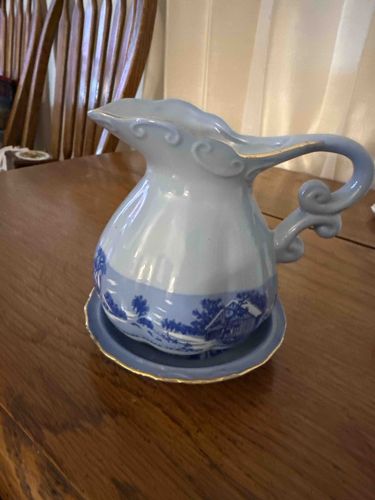
This item is a decorative porcelain ewer (pitcher) and basin (dish) set, characterized by an elegant Victorian or possibly Neo-Classical aesthetic. The ewer measures approximately 8-10 inches in height, based on its proportion to the table, and features a light blue glaze that transitions to a darker, more vibrant blue on the lower half. The upper portion of the ewer's body is a solid, glossy pale blue. A striking landscape scene, rendered in a dark blue transferware style, encircles the base of the ewer, depicting what appears to be houses or buildings nestled among trees and hills. The rim of the ewer is elegantly scalloped or fluted, with delicate scrollwork in relief on its upper edge. The handle is an 'S' shape, also with intricate scroll accents, and appears to be integrated seamlessly into the body. Both the ewer's rim and the top edge of the handle exhibit gold gilding, which shows signs of wear, particularly on the handle, suggesting age and handling. The accompanying basin is circular, with a matching light blue glaze and a gold-gilded rim. The design of the set aims to evoke a sense of refinement and historical charm. The visible wear on the gilding, such as small chips or fading, indicates that the item is either an antique or vintage piece, likely from the late 19th to early 20th century. The craftsmanship, particularly the detailed transferware and the molded decorative elements, points to a good quality decorative ceramic piece. There are no immediate visible cracks or significant damage, only the aforementioned wear on the gilding.
AI Appraisal Report
Upon visual examination of this Victorian-style porcelain ewer and basin set, I observe a charming decorative piece. The use of a two-tone blue glaze, with a lighter upper half transitioning to a darker lower portion, is aesthetically pleasing. The transferware landscape scene at the ewer’s base adds a distinct decorative element, consistent with late 19th to early 20th-century ceramic production. The scalloped rim, scrollwork, and 'S'-shaped handle with its intricate accents contribute to the overall Neo-Classical or Victorian charm. The gold gilding on both the ewer and basin’s rim, as well as the handle, shows expected wear, particularly visible on the handle. This wear is consistent with age and regular handling, supporting its likely antique or vintage status. No significant chips, cracks, or repairs are evident from the image, which is a positive factor for its value.
Market conditions for decorative ceramic ewer and basin sets of this style are stable but not exceptionally strong for mass-produced examples. Demand is primarily from collectors of Victorian decorative arts or individuals seeking period-appropriate decor. While aesthetically pleasing, similar sets without definitive manufacturer marks or provenance tend to fall into a moderate price range. Factors impacting value positively include the good overall condition (aside from gilding wear), the complexity of the transferware, and the detailed molding. However, the absence of a visible maker's mark limits its potential as a rare or highly sought-after piece.
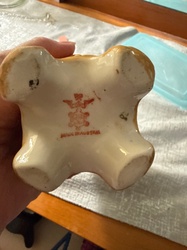
It is important to note that this appraisal is based solely on visual inspection of the provided image. For full authentication and a more precise valuation, an in-person examination would be crucial. This would allow for a thorough inspection of the material quality, confirmation of no hidden damage or repairs, and identification of any maker’s marks, which are often located on the base. Provenance documentation, if available, describing its history of ownership or acquisition, would also significantly aid in determining authenticity and could potentially increase its value. Without these, the authenticity of its age and origin remains an assessment based on stylistic cues and condition consistent with the period.