These notes were written by the person who submitted this item. Appraiser.AI has not verified them, and the AI's identification and estimate may rely on them.
AI Estimated Value
Not an official valuation
$400-600
AI estimate as of August 25, 2025 · verify with a professional before acting
AI-Generated · Verify before acting
Everything on this page is generated by AI for informational purposes only. AI can make mistakes — the AI may misidentify items or misattribute them (artist, maker, brand, designer, origin, era). This is not an official valuation and should not be used for insurance, sale, tax, estate, legal, or lending purposes — or any decision requiring a certified appraisal. It is not an authoritative claim about any person, brand, or rights holder — do not share or rely on it as a factual statement about a third party. Always consult qualified professionals before making financial decisions.
This analysis also relies on unverified notes provided by the user, which may be incomplete or inaccurate and could affect the result.
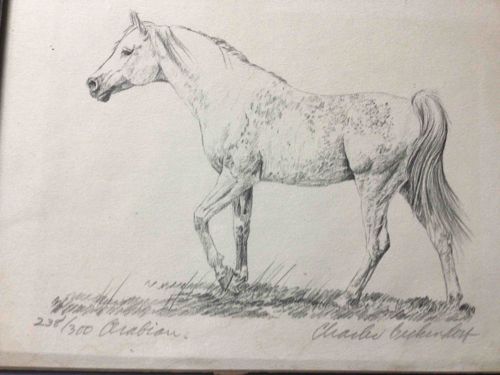
This item is a limited edition art print, specifically a lithograph, depicting an Arabian horse in profile, walking across a grassy foreground. The print is rendered in monochrome, likely black ink or graphite on off-white or cream-colored paper. The dimensions are not provided but it appears to be of a medium size, suitable for framing. The horse is finely detailed, showcasing its distinctive head profile, muscular build, and a flowing tail. The artist has used careful shading and line work to create texture, particularly notable in the dappled pattern on the horse's coat and the individual strands of its mane and tail. The foreground is lightly sketched to indicate grass. Visible markings include '238/300 Arabian.' inscribed in the lower left corner, indicating it is the 238th print out of a total edition of 300, and confirming the subject matter. The artist's signature, "Charles Buckendorf," is present in the lower right corner. The print shows some signs of age, with slight discoloration or foxing consistent with older paper, and there might be some minor handling marks or dust, though its overall condition appears good for its age. The edges of the paper, particularly the top and left, show slight browning or wear that suggests it might have been previously framed or stored. The craftsmanship is evident in the detailed portrayal and the clarity of the lines, indicative of a quality lithographic process from the latter half of the 20th century or early 21st century given the printing methods and style.
AI Appraisal Report
I have examined the provided image of the Charles Buckendorf Arabian Horse Limited Edition Print. The print, a lithograph, presents an Arabian horse in profile, executed in monochrome with fine detail. Based on my visual assessment, the condition appears good for its age, though I note slight discoloration or foxing, particularly at the edges, consistent with an older paper-based item that may have been previously framed or stored. The clear inscription '238/300 Arabian.' and the visible signature 'Charles Buckendorf' lend strong initial support to its authenticity and the stated edition number. However, physical examination would be crucial to confirm the authenticity of the signature and the print process, ensuring it's not a facsimile. Furthermore, an in-person assessment would allow for a precise evaluation of paper quality, type of foxing, potential hidden damage, and the exact medium (black ink or graphite). I cannot definitively verify authenticity from images alone; provenance documentation, such as a certificate of authenticity or purchase receipts, would greatly enhance verification. Without a physical inspection, scientific testing of the ink/graphite or paper aging is not possible.
Regarding market conditions, limited edition prints by known equestrian artists like Charles Buckendorf generally maintain a steady demand, especially among collectors of horse art. The subject matter, an Arabian horse, is highly popular. For comparable sales, I look for similar limited edition prints by Buckendorf or other established equestrian artists, considering edition size, subject appeal, and condition. Rarity is moderate given the edition size of 300, which is not overly restrictive. Key factors impacting value include the artist's reputation, the print's condition, the appeal of the subject, and the clear edition numbering. Discoloration or foxing can slightly depress value if severe, but in this case, it appears minor. Assuming the signature and print are indeed authentic, and the condition is as good as it appears, this is a desirable piece for collectors. I have factored in the current market for similar works and the limited edition status. The main limitation in my valuation is the inability to conduct an in-person authenticity verification.