AI estimate as of November 17, 2025 · verify with a professional before acting
AI-Generated · Verify before acting
Everything on this page is generated by AI for informational purposes only. AI can make mistakes — the AI may misidentify items or misattribute them (artist, maker, brand, designer, origin, era). This is not an official valuation and should not be used for insurance, sale, tax, estate, legal, or lending purposes — or any decision requiring a certified appraisal. It is not an authoritative claim about any person, brand, or rights holder — do not share or rely on it as a factual statement about a third party. Always consult qualified professionals before making financial decisions.
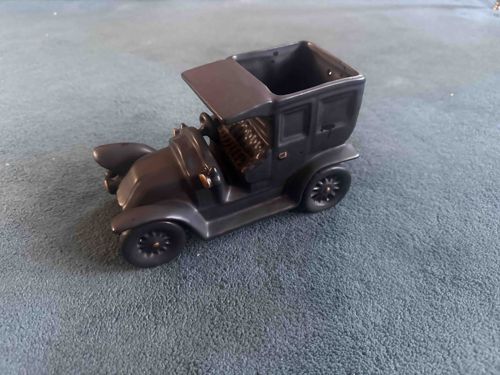
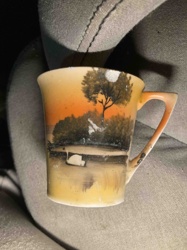
This item is a detailed miniature representation of an early 20th-century sedan car, likely functioning as a planter or vase. It is predominantly dark gray or black in color, suggesting a ceramic or glazed pottery material, possibly a matte finish. The car features classic design elements of vehicles from the 1900s to 1920s, including distinct front fenders that curve over the wheels, side running boards, and a box-like passenger cabin with an open roof. The wheels are solid, dark-colored, and feature spokes, adding to its vintage aesthetic. The front of the car includes a rudimentary headlight on the left side, though the right one is not clearly visible. The interior of the passenger cabin is open and appears to be textured, possibly with a wicker or woven pattern, and is painted in a contrasting lighter, brownish-gold tone. The cabin's side doors and rear are well-defined with subtle panel lines. There are no obvious maker's marks or signatures visible from the provided image. The overall condition appears good, with no apparent chips, cracks, or significant wear. The item exhibits good craftsmanship for a decorative piece, with attention paid to replicating historical vehicle details. Its utility as a planter or vase is indicated by the open top of the passenger compartment. It appears to be an ornamental piece, likely used for home decoration, and could be from the mid to late 20th century, replicating an older style.
AI Appraisal Report
Based on my visual examination of the provided image, this Vintage Sedan Car Miniature Planter/Vase appears to be in very good condition, showing no immediately obvious chips, cracks, or significant wear. The matte dark gray/black finish and the brownish-gold textured interior are consistent with a ceramic or glazed pottery construction. The replication of early 20th-century automotive design, particularly the distinct fenders, running boards, and spoke wheels, suggests it is an ornamental piece designed to evoke a vintage aesthetic. While it is presented as a 'Vintage' item, its style appears to be a reproduction of an older period, likely manufactured in the mid to late 20th century. My assessment of authenticity as a true antique is limited by the image; it appears to be a decorative collectible from a later period. Had this been a true antique car model from the early 20th century, the value would be significantly higher.
Market conditions for such decorative items are generally stable but not experiencing rapid appreciation. Comparable items, typically novelty planters or decorative vehicle figurines made of ceramic, often sell in the $40-$120 range depending on size, craftsmanship, and specific design appeal. Its dual utility as a planter or vase adds a layer of practical appeal. Demand for such specific decorative collectibles is niche, primarily appealing to collectors of automotive memorabilia or vintage-style home decor. While not exceptionally rare, its good condition and pleasing design contribute positively to its marketability. The lack of visible maker's marks is a detractor for higher value, as identified manufacturers often command better prices.
Factors significantly impacting its value include its excellent apparent condition and detailed replication of an older style. However, its likely status as a reproduction rather than an actual antique limits the top-end value. For full authentication and to ascertain its precise age and manufacturer, an in-person examination would be crucial. This would allow for a tactile inspection of the material, a thorough search for hidden maker's marks, and potentially spectroscopic analysis to determine the composition of the ceramic and glazes. Without physical inspection or provenance documentation (e.g., original sales receipts or family history), its exact manufacturing date and origin remain speculative.