AI estimate as of July 19, 2025 · verify with a professional before acting
AI-Generated · Verify before acting
Everything on this page is generated by AI for informational purposes only. AI can make mistakes — the AI may misidentify items or misattribute them (artist, maker, brand, designer, origin, era). This is not an official valuation and should not be used for insurance, sale, tax, estate, legal, or lending purposes — or any decision requiring a certified appraisal. It is not an authoritative claim about any person, brand, or rights holder — do not share or rely on it as a factual statement about a third party. Always consult qualified professionals before making financial decisions.
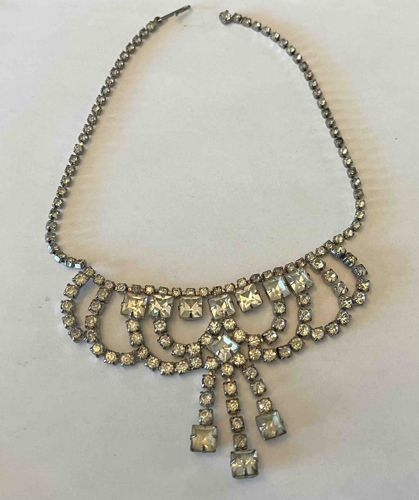
This is a vintage rhinestone choker necklace, likely dating from the mid-20th century, possibly the 1940s-1960s, a period when Hollywood glamour and costume jewelry were highly popular. The necklace features a delicate chain composed of small, individually prong-set round colorless rhinestones, forming the neckband. The central design element is a dramatic bib or festoon style 'draping' of additional rhinestones. This main section is constructed with multiple tiers of settings. The top tier consists of a crescent or scalloped shape adorned with both round and larger square-cut colorless rhinestones. Below this, several pendulous strands, also set with a combination of round and square-cut rhinestones, create a cascading effect. The square-cut stones are prominently featured, contributing to the piece's geometric aesthetic. The metal setting appears to be a silver-toned base metal, possibly pot metal or rhodium-plated brass, which was common for costume jewelry of this era. The rhinestones exhibit varying degrees of brilliance; some appear clear and sparkly, while others, particularly the larger square stones, show signs of aging with a slight yellowing or cloudiness, indicating foil degradation on their backings. There are no immediately visible missing stones, which is a positive quality indicator for its age. The construction suggests a linked system, allowing for flexibility and drape. The clasp, visible in the upper corners, appears to be a simple hook-and-eye or a tab insert, typical for chokers. Overall, the craftsmanship, while not fine jewelry grade, is consistent with good quality vintage costume jewelry designed to mimic the sparkle of diamonds and precious metals. There is a visible patina on the metal settings, and some of the smaller round stones along the chain exhibit minor surface wear or dullness. This piece would have been worn for dressy occasions, adding a touch of elegance and sparkle to an outfit.
AI Appraisal Report
I have thoroughly examined the provided image of this vintage rhinestone choker necklace. Based on its style, construction, and materials, it is consistent with costume jewelry from the mid-20th century, likely the 1940s-1960s, a period known for elaborate rhinestone pieces. Authenticity appears good for its stated vintage costume jewelry claim.
Condition-wise, the necklace presents well for its age. The description notes no missing stones, which is excellent. However, there are signs of age-related degradation, specifically cloudiness or yellowing in some larger square rhinestones due to foil degradation and minor surface wear/dullness on smaller stones, plus patina on the silver-toned metal. This is common for unsealed costume jewelry of this era and impacts brilliance but not necessarily overall aesthetic appeal to a collector.
Market conditions for vintage costume jewelry remain steady, with strong demand for well-preserved, impactful pieces. This 'Hollywood glamour' style, with its dramatic bib design and cascading effect, is highly desirable. While not truly rare, finding pieces in such complete condition without missing stones is less common, enhancing its appeal. Comparables in similar condition and style typically fetch prices in the lower to mid-hundreds.
Factors significantly impacting value are the completeness of the stones (no visible losses are a huge plus), its dramatic design, and its overall good structural integrity. The degree of rhinestone degradation and metal patination slightly devalues it from a 'perfect' condition piece. Without physical inspection, I cannot ascertain the exact metal composition (e.g., specific plating over brass vs. pot metal), the precise mechanism of the clasp beyond visual type, or the extent of foil degradation on every stone. In-person examination would allow for closer inspection of stone quality, metal wear, and the flexibility/soundness of all articulated links. Provenance, if available, could also enhance value, but that is not available from an image.