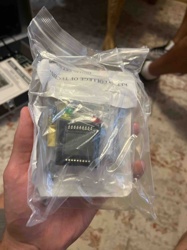
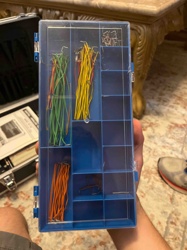
These notes were written by the person who submitted this item. Appraiser.AI has not verified them, and the AI's identification and estimate may rely on them.
AI Estimated Value
Not an official valuation
$50 - $120
AI estimate as of September 12, 2025 · verify with a professional before acting
AI-Generated · Verify before acting
Everything on this page is generated by AI for informational purposes only. AI can make mistakes — the AI may misidentify items or misattribute them (artist, maker, brand, designer, origin, era). This is not an official valuation and should not be used for insurance, sale, tax, estate, legal, or lending purposes — or any decision requiring a certified appraisal. It is not an authoritative claim about any person, brand, or rights holder — do not share or rely on it as a factual statement about a third party. Always consult qualified professionals before making financial decisions.
This analysis also relies on unverified notes provided by the user, which may be incomplete or inaccurate and could affect the result.
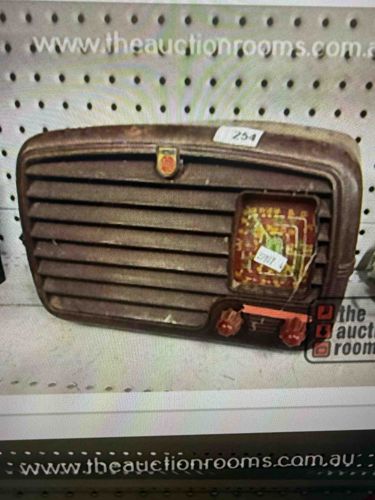
This is a vintage portable tube radio, likely manufactured by Philips, characterized by its compact, rectangular form factor with a distinctly curved top edge. The casing appears to be constructed from Bakelite or a similar early plastic material, exhibiting a dark brown, almost mottled color. The front grille is formed by horizontal louvers, offering a classic aesthetic typical of radios from the mid-20th century. At the top center of the grille, a small, shield-shaped emblem with an orange or red inset, likely the Philips logo, is prominently featured, although its details are somewhat obscured by wear and dirt. To the right of the grille, there's a smaller, recessed section housing the tuning dial, which appears to be a back-lit glass or plastic panel with numerical frequencies and possibly station markers. The dial shows significant wear, with what might be adhesive residue or an old sticker obscuring parts of its surface. Below the tuning dial, there are two prominent control knobs, seemingly made of orange or reddish Bakelite or plastic, suggesting volume and tuning functions. The exterior surface displays considerable patina, pitting, and what appears to be dirt accumulation, indicating overall aged condition without obvious signs of major cracks or repairs, though localized wear is present. The material's sheen is dulled by age and handling. This item embodies the design principles of the 1950s, emphasizing functionality and a robust, enclosed design for portability. The visible condition suggests it has been stored for an extended period and would require cleaning and possible restoration for optimal functionality and aesthetic appeal. The craftsmanship appears to be industrial standard for the period, with a molded casing and clearly defined functional elements.
AI Appraisal Report
I have examined the provided image of what appears to be a Vintage Philips Portable Tube Radio, potentially a BX200U or similar model from the 1950s. The item's compact, rectangular form factor with a curved top edge and dark brown Bakelite/early plastic casing aligns well with Philips' designs from that era. The horizontal louvered grille, shield-shaped logo, and orange/red Bakelite control knobs are all consistent with period aesthetics and typical Philips components. Based on these visual cues and the owner's description, I believe this is an authentic Philips tube radio.
The condition, however, is a significant factor in the appraisal. The radio displays considerable patina, pitting, dirt accumulation, and dulled sheen, indicating extensive age and storage. The tuning dial shows significant wear, with what might be adhesive residue. While there are no obvious major cracks or repairs, the overall aged and dirty state suggests it would require thorough cleaning, cosmetic restoration, and likely internal electrical servicing to be fully functional and aesthetically appealing. This 'project' condition significantly impacts its market value.
Market conditions for vintage tube radios are generally steady, but demand is highest for professionally restored, fully functional units or rare, exceptionally well-preserved examples. This radio, in its current state, falls into the category of a collector's restoration project. Comparable unrestored Philips tube radios from the 1950s typically sell in the $50-$150 range, with the lower end for those requiring more extensive work. The specific model's rarity also plays a role, and while Philips produced many radios, the BX200U is not exceptionally rare.
Factors impacting value include the current non-working status (assumed due to condition), the need for cosmetic and electrical restoration, and the general wear. The Philips branding adds some appeal, but it's not a high-end or exceptionally collectible model. For a full authentication, physical examination would be crucial to inspect internal components for originality, verify serial numbers, and confirm the casing material. Internal circuit boards and components often bear manufacturing dates and model numbers which would either confirm or deny the initial assessment.