AI estimate as of December 3, 2025 · verify with a professional before acting
AI-Generated · Verify before acting
Everything on this page is generated by AI for informational purposes only. AI can make mistakes — the AI may misidentify items or misattribute them (artist, maker, brand, designer, origin, era). This is not an official valuation and should not be used for insurance, sale, tax, estate, legal, or lending purposes — or any decision requiring a certified appraisal. It is not an authoritative claim about any person, brand, or rights holder — do not share or rely on it as a factual statement about a third party. Always consult qualified professionals before making financial decisions.
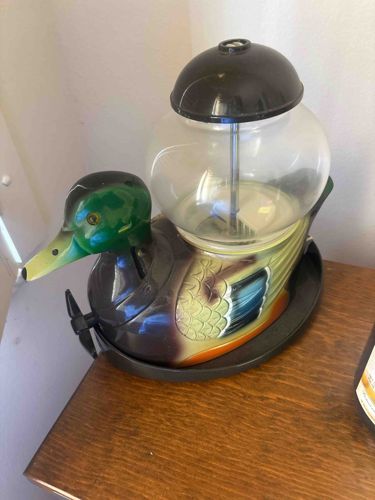
This item is a decorative gumball machine designed in the likeness of a mallard duck. It features a plastic or ceramic body, molded and painted to represent a male mallard, complete with a distinctive green head and iridescent blue-green markings on the wings, simulating feathers. The duck's body transitions from a dark brown or black on the back to lighter brown, yellow, and orange tones on the underside and wing details, mimicking the natural plumage of a mallard. The texture of the 'feathers' on the duck's body appears to be raised or embossed, adding a tactile element to the design. A clear spherical glass or plastic globe sits securely on the duck's back, serving as the candy reservoir. This globe is topped with a dark, possibly black, domed lid, which likely functions as the opening for refilling and potentially conceals the dispensing mechanism. A metal rod runs through the center of the globe, which is typical for gumball machines to assist in dispensing or stirring the contents. The entire duck figure rests on a dark, oval-shaped base, suggesting stability and a finished look. On the left side of the duck's body, near the head, there is a black lever or handle which is presumably used to operate the dispensing mechanism. The overall condition appears to be good, with no immediately visible cracks, chips, or significant paint loss. The colors are vibrant, suggesting either well-preserved paint or a relatively modern manufacturing period. The craftsmanship indicates a mass-produced novelty item, likely from the mid-to-late 20th century, designed for home decor or as a functional children's toy. The item showcases a playful integration of an animal figurine with a candy dispenser.
AI Appraisal Report
Upon visual examination of the provided image, this Mallard Duck Gumball Machine appears to be in good overall condition. I observe vibrant colors and no immediately visible cracks, chips, or significant paint loss on the duck figure, suggesting either careful preservation or a more recent manufacturing date. The clear globe and metal rod also seem intact. Authenticity, based solely on this image, points to a mass-produced novelty item. The design elements, such as the molded plastic/ceramic body and the clear globe with a central rod, are consistent with gumball machines from the mid-to-late 20th century, likely 1970s-1990s.
Market analysis for similar decorative gumball machines, especially those featuring animal motifs, shows a moderate but niche demand. Comparables on online auction sites and vintage marketplaces typically sell in the $30-$80 range, depending on condition, size, and specific animal design. Mallard ducks are a common decorative theme, which slightly lowers rarity. Factors impacting its value negatively include its mass-produced nature and the lack of a known prestigious manufacturer. Positively, its apparent good condition and whimsical appeal contribute to its marketability.
Due to the limitations of image-only assessment, I cannot definitively verify the material composition (plastic vs. ceramic for the duck body), the integrity of the internal dispensing mechanism, or the absence of hairline cracks or repairs not visible in the photo. For full authentication and a more precise value, an in-person examination would be required to assess the mechanics, actual material, weight, precise dimensions, and hidden defects. Proving provenance documentation would also help confirm age and origin.