AI estimate as of November 8, 2025 · verify with a professional before acting
AI-Generated · Verify before acting
Everything on this page is generated by AI for informational purposes only. AI can make mistakes — the AI may misidentify items or misattribute them (artist, maker, brand, designer, origin, era). This is not an official valuation and should not be used for insurance, sale, tax, estate, legal, or lending purposes — or any decision requiring a certified appraisal. It is not an authoritative claim about any person, brand, or rights holder — do not share or rely on it as a factual statement about a third party. Always consult qualified professionals before making financial decisions.
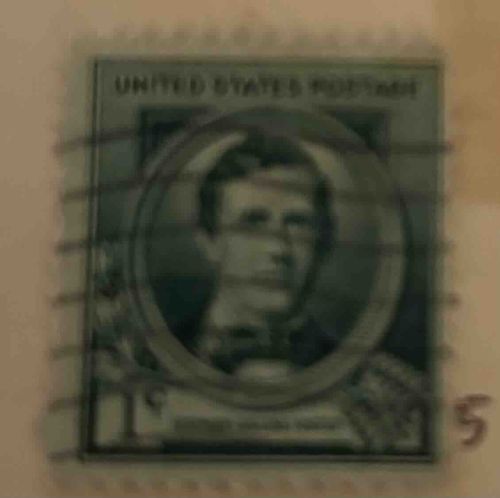
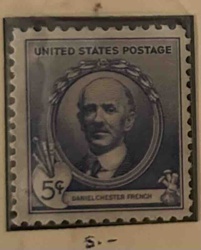
This item is a used, square-shaped postage stamp from the United States, featuring a portrait of George Washington. The stamp is predominantly blue-green in color, with a darker shade for the portrait and text, and a lighter shade for the background. The central image is an oval-framed bust portrait of George Washington, facing slightly to his right. His features, including his wig and formal attire, are discernible despite the low resolution of the image. Above the portrait, the text "UNITED STATES POSTAGE" is printed in capital letters. Below the portrait, the denomination "1 CENT" is clearly visible, with the numeral '1' at the bottom left. The stamp has perforated edges, indicating it was separated from a sheet of stamps. There are faint diagonal lines or marks across the stamp, possibly a cancellation mark from postal use, which suggests it is a 'used' stamp. The overall condition appears fair, with visible wear consistent with its age and use. The colors seem somewhat faded due to age. A handwritten number '5' is visible in the bottom right corner, partially on the stamp and partially on the surface it's placed on, which is likely an inventory or collection number added by a previous owner. The exact age is difficult to ascertain from the image alone, but the design and the figure of George Washington suggest it could be from the late 19th or early 20th century, a common period for such designs on US postage stamps. The craftsmanship appears to be typical of mass-produced government-issued stamps of the era.
AI Appraisal Report
I have examined the provided image of the United States 1 Cent Postage Stamp featuring George Washington. Based on this visual inspection, I can confidently say this appears to be a genuine U.S. postage stamp. The design, including the portrait of Washington, the 'UNITED STATES POSTAGE' text, and the '1 CENT' denomination, is consistent with known issues of the Washington-Franklin series, likely issued between 1908 and 1922. The blue-green color also aligns with this series.
Its condition is 'used', evidenced by what appear to be cancellation marks, and the perforated edges are intact, although some wear is visible due to age and circulation. The handwritten '5' in the corner is a minor blemish but not uncommon for collector's identification. Fading is present, which is typical for stamps of this era that have been exposed over time.
In terms of market conditions, this specific denomination and design from the Washington-Franklin series was produced in extremely high quantities, making it very common. While popular with new and casual collectors, it is not considered rare. Demand exists, but the ample supply keeps prices low for common used examples.
Factors impacting value: The major factor here is the abundance of this stamp. Better centering, clearer cancellations, and pristine color would command slightly higher prices, but this example is fairly average. The blue-green 1-cent Washington-Franklin stamps are among the most common U.S. stamps.
Limitation on authenticity: While the visual characteristics strongly suggest authenticity, definitive authentication would require an in-person examination to verify paper type, watermark (if applicable for the specific issue), gum type (if unused), and precise perforation measurements. Microscopic examination could confirm the printing process and rule out modern counterfeits, though counterfeits of such common stamps are rare due to low value. Provenance documentation could add value for rarer items, but for this common stamp, it is not a significant factor.