AI estimate as of October 24, 2025 · verify with a professional before acting
AI-Generated · Verify before acting
Everything on this page is generated by AI for informational purposes only. AI can make mistakes — the AI may misidentify items or misattribute them (artist, maker, brand, designer, origin, era). This is not an official valuation and should not be used for insurance, sale, tax, estate, legal, or lending purposes — or any decision requiring a certified appraisal. It is not an authoritative claim about any person, brand, or rights holder — do not share or rely on it as a factual statement about a third party. Always consult qualified professionals before making financial decisions.
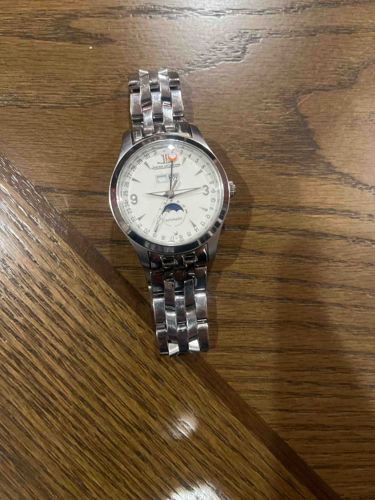
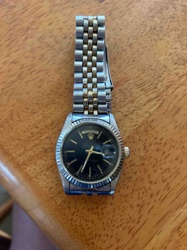
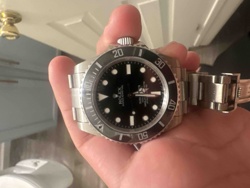
The item is a luxurious men's wristwatch, likely a Jaeger-LeCoultre Master Calendar Moonphase model, judging by the distinctive dial layout and branding. It features a round, polished silver-toned metal case, presumably stainless steel, with a white or off-white dial. The dial is intricate, displaying not only the time with silver-toned hour, minute, and central seconds hands, but also a full calendar complication and a moon phase indicator. Arabic numerals are present at the 3, 6, 9, and 12 o'clock positions, with stick markers for the other hours. A date ring encircles the outer edge of the dial, pointed to by a crescent-tipped hand originating from the center. Below the 12 o'clock position, 'Jaeger-LeCoultre' and 'AUTOMATIC' are inscribed. Below the center hands, there appears to be a day and month aperture, and at the 6 o'clock position, a prominent moon phase display is visible within a sub-dial. The watch is fitted with a multi-link silver-toned metal bracelet, likely matching the case material, which exhibits a polished finish. The overall condition appears to be good with some minor surface scratches visible on the metal components consistent with regular wear. No major damage or repairs are immediately evident. The craftsmanship suggests a high-end luxury timepiece, characterized by precision-engineered components and a sophisticated mechanical movement. Based on these features, the watch likely dates from the late 20th century to early 21st century.
AI Appraisal Report
Upon visual examination of the provided image, I assess this gentleman's wristwatch to be a Jaeger-LeCoultre Master Calendar Moonphase model. The distinctive dial layout, complete with day, date, month, and moon phase complications, alongside the prominent 'Jaeger-LeCoultre' and 'AUTOMATIC' inscriptions, strongly indicates authenticity as a product of this esteemed manufacture. The watch features a round, polished silver-toned case and a multi-link metal bracelet, likely stainless steel, paired with a white or off-white dial. The craftsmanship evident in the intricate dial, applied numerals, and hand finishes is consistent with high-end luxury watchmaking.
The overall condition appears good, showing minor surface scratches on the metal components, which is expected with regular wear for a timepiece of its likely age (late 20th to early 21st century). No significant damage or evidence of extensive repairs is immediately apparent. These minor cosmetic imperfections would not significantly detract from its value.
Market conditions for pre-owned Jaeger-LeCoultre Master Calendar models are generally stable, with consistent demand for well-maintained examples. Comparables, such as other Master Calendar references in stainless steel, typically command values within the range provided. While not exceptionally rare, the integrated triple calendar and moon phase complication adds to its desirability.
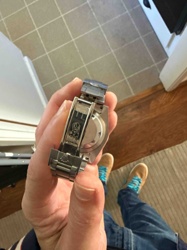
Factors impacting value positively include the brand's prestige, the complexity of the movement (automatic triple calendar with moon phase), and the classic, enduring design. The primary limitation in this appraisal is the reliance on images alone. I can confirm its authenticity based on visual cues; however, for full authentication, I would require an in-person examination to inspect movement serial numbers, case hallmarks, and the internal components for originality. Additionally, provenance documentation such as original box and papers would enhance valuation. Scientific testing on materials would further verify manufacturing specifics. Without these, the appraisal remains largely based on external visual characteristics and market comparables.