AI estimate as of September 17, 2025 · verify with a professional before acting
AI-Generated · Verify before acting
Everything on this page is generated by AI for informational purposes only. AI can make mistakes — the AI may misidentify items or misattribute them (artist, maker, brand, designer, origin, era). This is not an official valuation and should not be used for insurance, sale, tax, estate, legal, or lending purposes — or any decision requiring a certified appraisal. It is not an authoritative claim about any person, brand, or rights holder — do not share or rely on it as a factual statement about a third party. Always consult qualified professionals before making financial decisions.
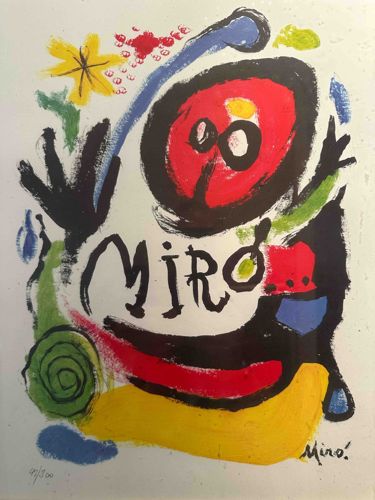
This item is a vibrant lithograph or serigraph print, likely a poster, by Joan Miró, specifically created for the Expo '70 World's Fair in Osaka, Japan. The artwork is characterized by Miró's signature Surrealist and abstract style, featuring bold, primary, and secondary colors (red, yellow, blue, green, black) against an off-white background. The central motif appears to be an abstract, somewhat anthropomorphic form with a large red circular 'head' containing two white-rimmed black ovals and a small yellow circle. Surrounding this are various whimsical and organic shapes: a yellow starburst or flower, red splatters resembling dots or berries, a prominent blue curvilinear stroke, a black hand-like form with five digits, and a green spiral. The artist's name, 'MIRO', is handwritten in large, gestural black letters across the center of the piece, integrating directly into the composition rather than functioning merely as a signature. A smaller, more formal signature, 'Miró', is visible in black ink in the lower right corner. In the lower left corner, 'Miro.' is visible, along with an edition number '97/300', indicating that this is a limited edition print. The medium appears to be paper, and the printing technique results in a somewhat textured, painterly effect, suggesting lithography or screenprinting. The colors are generally bright and well-saturated, indicating good preservation. There are no immediately apparent significant condition issues such as tears, folds, or severe discoloration, though minor surface irregularities might be present upon closer inspection. The overall style is characteristic of Miró's late career, emphasizing playful abstraction and bold graphic impact. The craftsmanship appears to be of high quality, consistent with fine art printmaking.
AI Appraisal Report
Based on my visual examination of the provided image, this Joan Miró poster for Expo '70 appears to be an authentic limited edition print, likely a lithograph or serigraph, signed 'Miró' in the lower right and editioned '97/300' in the lower left. The artistic style, vibrant color palette, and abstract forms are highly consistent with Miró's iconic work from that period. The presence of the large, integrated 'MIRO' within the composition is also characteristic of his designs for major cultural events.
The condition appears to be very good to excellent. The colors are bright and well-saturated, indicating good preservation with no visible foxing, significant fading, or major creases. Without physical inspection, I cannot confirm the absence of minor surface abrasions, pinholes, or faint discoloration, but these are not apparent in the image. The apparent lack of significant damage contributes positively to its value.
Market conditions for Miró's limited edition prints, especially those from significant events like World's Fairs, remain strong. Comparables of Miró's signed and numbered lithographs from the late 1960s to early 1970s, particularly those with strong graphic impact, typically realize several thousand dollars at auction and through reputable dealers. The limited edition of 300 enhances its rarity and desirability. The integration of his name into the artwork also adds a unique design element that collectors appreciate.
To fully authenticate and confirm the condition, a physical examination would be essential to inspect the paper quality, printing process (lithograph vs. serigraph), presence of any publisher's or printer's marks, and to assess any subtle imperfections not visible in the image. Provenance documentation, such as original receipts or exhibition history, would also strengthen its authenticity and value. Without these, my assessment of authenticity is based solely on stylistic consistency and visible signatures/edition numbers.