AI Appraisal Estimate

AI-generated estimates · not official valuations

From the user

What was submitted

Photo and notes provided by the user — not generated by AI

Submitted item photo
Submitted photo · June 1, 2026

User's notes

No additional notes provided.

AI analysis below

AI appraisal

AI analysis & estimate

AI-Generated · Verify before acting

Everything below is generated by AI for informational purposes only. AI can make mistakes — the AI may misidentify items or misattribute them (artist, maker, brand, designer, origin, era). This is not an official valuation and should not be used for insurance, sale, tax, estate, legal, or lending purposes — or any decision requiring a certified appraisal. It is not an authoritative claim about any person, brand, or rights holder — do not share or rely on it as a factual statement about a third party. Always consult qualified professionals before making financial decisions.

Read the full disclaimer

AI Identification

·Not independently authenticated·Verify before acting

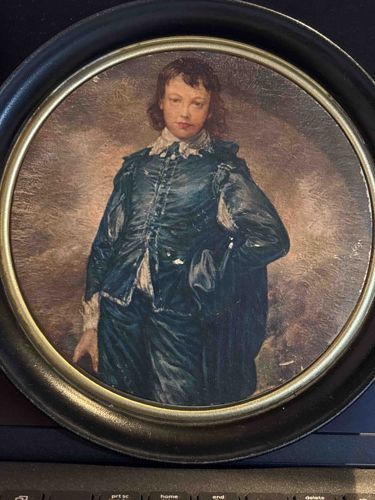
Miniature Reproduction of Thomas Gainsborough's 'The Blue Boy'

Fine Art / Decorative Collectibles

AI Estimated Value

·Not an official valuation·Verify before acting

$15.00 - $35.00

As of June 1, 2026

AI Item Analysis

·AI can make mistakes·Verify before acting
This item is a circular miniature reproduction of the famous 1770 oil painting 'The Blue Boy' by Thomas Gainsborough. The image depicts Jonathan Buttall dressed in a 17th-century style blue silk outfit with a lace collar and cuffs. Physically, the piece is housed in a round, dark-finished wooden or composite frame featuring a thin decorative gold-toned inner fillet or bezel. The artwork appears to be a printed or transfer-applied reproduction rather than an original hand-painting, as evidenced by the surface texture and slight color shift. The color palette is dominated by the subject's vibrant Prussian blue suit against a blended, dark landscape background. Notable features include the subject's distinct pose with one hand on his hip and a cape draped over his arm. Regarding condition, there is a visible white scuff or loss of pigment on the subject's lower jacket area and minor surface wear along the edges of the frame. The circular tondo format is common for 20th-century decorative souvenirs or home accents. No specific maker's marks are visible on the front. This style of reproduction was highly popular in the mid-to-late 20th century as a piece of traditional wall décor, reflecting the enduring popularity of the original masterpiece housed at the Huntington Library.
AI Appraisal Report

·AI can make mistakes·Verify before acting
I have conducted a visual examination of this miniature reproduction of Thomas Gainsborough’s 'The Blue Boy.' Structurally, the item is a circular tondo featuring a dark-toned frame with a metallic inner bezel. My assessment indicates this is a mass-produced decorative item rather than an original 18th-century work or a high-quality hand-painted ivory miniature. The surface shows characteristic signs of a mechanical transfer or lithographic process, evidenced by the color saturation and lack of impasto. Condition is fair to good; however, a significant white scuff on the subject's lower jacket represents a loss of pigment that diminishes its aesthetic and secondary market value. Market demand for mid-20th-century 'Old Master' reproductions is currently low, as these items were produced in high volumes for the souvenir and home décor markets. Rarity is non-existent, and comparable sales in online auctions typically range from $10 to $40 depending on frame quality and condition. The damage noted on the portrait further restricts its value to the lower end of the spectrum. Limitations of this appraisal: This evaluation is based solely on digital imagery. A definitive determination of the substrate (e.g., paper, plastic, or celluloid) and a confirmation that no hand-painting exists would require a physical inspection under 10x magnification. To elevate this item's status, provenance documentation or a maker's mark on the reverse of the frame would be necessary. Scientific testing, such as UV fluorescence, could definitively rule out older pigments, though the visual evidence strongly suggests a modern production timeline.

Get your items appraised

Instant estimates of your treasures with AI-powered appraisals

Browse More Appraisals