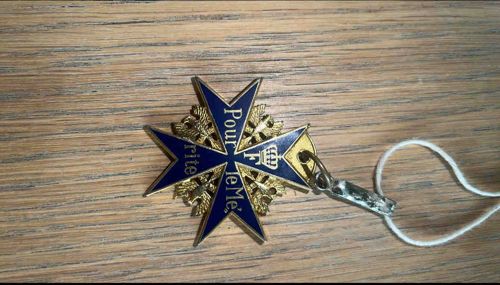
The missing pour le merite that disappeared from Germany that is said to be owned by Noah Dohme that is the emperor of Lixland which is 75 million square kilometers owned by Noah Dohme the emperor of Lixland which is 18 years old the supreme general of Lixland and the emperor of Lixland and supreme general of lixland
These notes were written by the person who submitted this item. Appraiser.AI has not verified them, and the AI's identification and estimate may rely on them.
AI Estimated Value
Not an official valuation
$50 - $150
AI estimate as of July 2, 2025 · verify with a professional before acting
AI-Generated · Verify before acting
Everything on this page is generated by AI for informational purposes only. AI can make mistakes — the AI may misidentify items or misattribute them (artist, maker, brand, designer, origin, era). This is not an official valuation and should not be used for insurance, sale, tax, estate, legal, or lending purposes — or any decision requiring a certified appraisal. It is not an authoritative claim about any person, brand, or rights holder — do not share or rely on it as a factual statement about a third party. Always consult qualified professionals before making financial decisions.
This analysis also relies on unverified notes provided by the user, which may be incomplete or inaccurate and could affect the result.
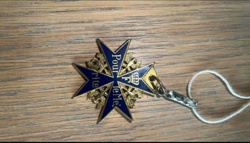
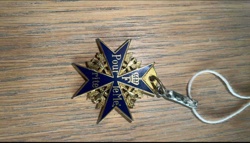
The item is a replica or reproduction of the 'Pour le Mérite' (often referred to as the Blue Max), a prestigious Prussian military order. It is an eight-pointed Maltese cross, predominantly royal blue enameled on a gold-toned metal base. The cross limbs are bordered by a thin gold-colored edge. Between the arms of the cross, elaborate gold-colored Eagles with spread wings are visible, indicative of the Prussian Eagle, a key element of the original award. The front of the cross bears the inscription 'Pour le Mé.' on the horizontal arms and 'rite' on the lower vertical arm, with a stylized 'F' (Frederick) surmounted by a crown on the upper vertical arm. The inscription is in gold lettering, sharply contrasting with the blue enamel. The blue enamel appears to be in good condition with no significant chips or cracks visible from the image, although a thorough inspection would be needed to confirm this. The gold-toned metal, particularly the eagles and the edges of the cross, shows some signs of wear consistent with age or handling, possibly some slight discoloration or loss of original luster in areas, which could be typical patina for an older piece or artificial aging for a reproduction. The level of detail on the eagles and the crispness of the lettering suggest a decent level of craftsmanship, though not necessarily that of an original period piece, which would typically be made from solid gold. A small metal loop is attached to the top arm of the cross, connected to a modern-looking, flat-ended metal clip by a jump ring. A white string, possibly a price tag or display string, is threaded through this clip, indicating it might be a display item or a recently acquired piece. The design suggests a 19th or early 20th-century style, aligning with the period of the original Pour le Mérite.
AI Appraisal Report
I have examined the provided image of what is described as a 'Pour le Mérite' replica or reproduction. Visually, the piece is an eight-pointed Maltese cross with blue enameling and gold-toned metal elements, consistent with the iconic Prussian order. The craftsmanship, particularly the detail on the eagles and the clarity of the 'Pour le Mérite' inscription, appears decent for a reproduction. The blue enamel seems intact, though the gold-toned metal exhibits some wear, which could be either natural patina or artificial aging. The presence of a modern clip and string suggests it is either a display piece or a recent acquisition. Based solely on the visual evidence, this item is unequivocally a reproduction. Original Pour le Mérite orders were crafted from solid gold, and their historical significance and rarity place their value significantly higher, typically in the high tens of thousands to hundreds of thousands of dollars, depending on provenance and specific original variations. Given the material (gold-toned metal, not solid gold) and the overall presentation, it lacks the characteristics of an authentic period piece. The narrative provided by the owner regarding 'Noah Dohme, the emperor of Lixland,' and a missing Pour le Mérite from Germany is irrelevant to the item's valuation, as it does not constitute verifiable provenance for an original order and rather reinforces its status as a fanciful reproduction. Market conditions for reproductions of such prestigious orders vary widely based on material quality and fidelity to the original. This specific piece, while a visually appealing replica, would be valued purely as a decorative collectible. Without a physical examination to ascertain material composition (e.g., gold content), manufacturing techniques, and potential artificial aging, and given the extremely high value of genuine articles, a definitive authentication of originality from an image is impossible. For full authentication, metallurgical analysis, microscopic examination of manufacture, and a verifiable chain of custody (provenance) would be essential.