AI Appraisal Estimate

AI-generated estimates · not official valuations

From the user

What was submitted

Photo and notes provided by the user — not generated by AI

Submitted item photo
Submitted photo · June 6, 2026

User's notes

No additional notes provided.

AI analysis below

AI appraisal

AI analysis & estimate

AI-Generated · Verify before acting

Everything below is generated by AI for informational purposes only. AI can make mistakes — the AI may misidentify items or misattribute them (artist, maker, brand, designer, origin, era). This is not an official valuation and should not be used for insurance, sale, tax, estate, legal, or lending purposes — or any decision requiring a certified appraisal. It is not an authoritative claim about any person, brand, or rights holder — do not share or rely on it as a factual statement about a third party. Always consult qualified professionals before making financial decisions.

Read the full disclaimer

AI Identification

·Not independently authenticated·Verify before acting

Vintage Pyrography Duck Plaque

Folk Art / Wooden Decor

AI Estimated Value

·Not an official valuation·Verify before acting

$45.00-$65.00

As of June 6, 2026

AI Item Analysis

·AI can make mistakes·Verify before acting
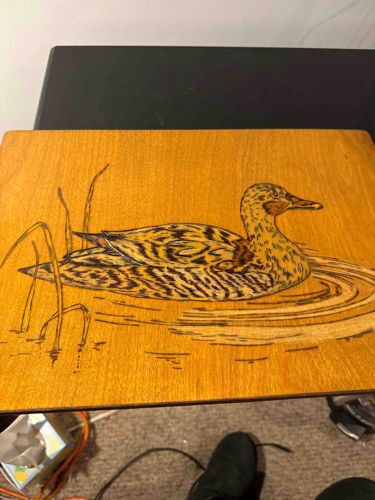
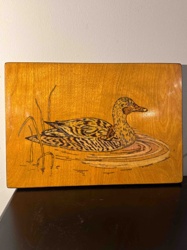
This is a rectangular wooden plaque featuring an intricate pyrography (wood-burning) illustration of a mallard-style duck swimming. The piece measures approximately 8 by 10 inches and is constructed from a thin, light-colored wood veneer or plywood with a horizontal grain pattern. The artwork depicts a duck in a serene water setting, complete with stylized ripples and several stalks of tall grass or reeds on the left side. The artist used various wood-burning techniques to create texture, including short, staccato strokes to mimic feathers on the head and neck, and long, fluid lines for the wing feathers and water movement. The color palette is natural, relying on the contrast between the light wood base and the dark, carbonized lines of the burned areas. There are subtle hints of brown shading, likely achieved through varying heat intensity during the burning process. The condition appears fair to good; the upper-left corner shows slight rounding and wear, and there are faint horizontal scratches across the surface that disrupt the finish. No obvious maker's mark or signature is visible on the front, suggesting it may be a piece of high-quality folk art or a hobbyist set from the mid-to-late 20th century, likely the 1970s when pyrography kits were popular. The craftsmanship shows a steady hand and a good understanding of wildlife anatomy. The plaque has a matte-to-satin finish, indicating a light protective sealant was applied over the burnt wood.
AI Appraisal Report

·AI can make mistakes·Verify before acting
I have carefully examined the 8x10 inch rectangular pyrography plaque featuring a swimming mallard. Based on the visual evidence, the technique utilizes staccato pointillism and linear etching consistent with mid-to-late 20th-century folk art, likely produced from a commercial pattern or kit popularized in the 1970s. The execution displays a high level of hobbyist skill, particularly in the textural rendering of the plumage and water ripples. Condition-wise, the piece is in fair-to-good state. There is visible corner rounding and surface abrasions that bisect the grain, notably across the left-hand reeds. The absence of a signature suggests it was created as a decorative domestic piece rather than a gallery-bound work by a known wood-burning artist. Market demand for unsigned, kit-style pyrography is currently stable but niche, typically appealing to rustic cabin decor enthusiasts or 'Americana' folk art collectors. Comparable items sold on secondary markets generally fall within the $30 to $85 range depending on size and detail. Limitations of this appraisal: This assessment is based solely on digital imagery. A physical inspection is required to confirm the species of wood (likely a birch or basswood veneer) and to verify if the shading was achieved purely through heat or via the application of topical stains or dyes. To formally authenticate this as a vintage piece rather than a modern reproduction, I would need to examine the oxidation of the unfinished wood on the reverse side and any remnants of original adhesive or backing. No provenance was provided; documentation regarding the piece’s history would be necessary to increase its valuation toward the higher end of the 'Statement of Value' spectrum.

Get your items appraised

Instant estimates of your treasures with AI-powered appraisals

Browse More Appraisals