These notes were written by the person who submitted this item. Appraiser.AI has not verified them, and the AI's identification and estimate may rely on them.
AI Estimated Value
Not an official valuation
$800-1,200
AI estimate as of September 27, 2025 · verify with a professional before acting
AI-Generated · Verify before acting
Everything on this page is generated by AI for informational purposes only. AI can make mistakes — the AI may misidentify items or misattribute them (artist, maker, brand, designer, origin, era). This is not an official valuation and should not be used for insurance, sale, tax, estate, legal, or lending purposes — or any decision requiring a certified appraisal. It is not an authoritative claim about any person, brand, or rights holder — do not share or rely on it as a factual statement about a third party. Always consult qualified professionals before making financial decisions.
This analysis also relies on unverified notes provided by the user, which may be incomplete or inaccurate and could affect the result.
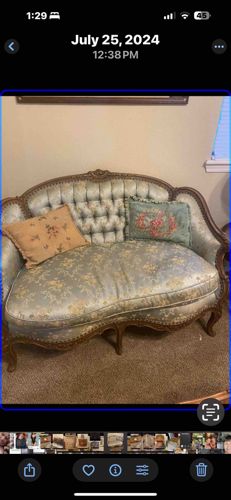
This item is a Victorian Rococo Revival settee, likely dating from the mid to late 19th century. Its overall form is characterized by elegant curves and ornate carvings, typical of the Rococo Revival style. The settee features a distinctive camelback design with a button-tufted backrest, upholstered in a pale blue or teal fabric. The tufting creates a pleasing texture and visual depth. The seat cushion, which appears to be a single, long cushion, is upholstered in a coordinating pale blue fabric with a subtle floral or botanical pattern, possibly woven or embroidered, in shades of yellow and cream. The exposed wooden frame is a rich, dark tone, indicative of carved walnut or mahogany, and exhibits elaborate rococo-inspired scrollwork and acanthus leaf motifs along the top crest rail, arms, and apron. The arms gracefully curve outwards and downwards, mirroring the serpentine front apron. The settee stands on cabriole legs, also carved, further emphasizing its Rococo influence. Visible condition issues include some wear to the upholstery, particularly on the seat where the fabric appears slightly compressed and possibly faded in areas. The wooden frame shows a consistent patina, suggesting age, but no obvious significant damage like breaks or deep scratches are discernible from the image. Small decorative nailhead trim is visible along the edges of the upholstery where it meets the wooden frame, a detail that speaks to traditional craftsmanship. Two throw pillows are present: one square, beige/tan with a small floral pattern, and another rectangular, light blue with elaborate pink and green floral embroidery, potentially a later addition or decorative flourish. The overall quality suggests a piece of furniture made with attention to decorative detail and a degree of craftsmanship, though not necessarily high-end artisan work.
AI Appraisal Report
Upon visual examination of the provided image, this Victorian Rococo Revival settee, likely dating from the mid to late 19th century, presents as an authentic piece of its period. The characteristic camelback form, button-tufted backrest, and elaborate rococo-inspired scrollwork and acanthus leaf motifs on the dark wood frame (suggesting carved walnut or mahogany) are all consistent with the style. The subtly patterned, pale blue seat upholstery, contrasting with the solid pale blue tufted back, adds to its period charm. The 'Goblin tapestry' mention, while interesting, typically refers to specific French tapestry workshops and doesn't directly apply here if it's merely a pattern description; further clarification would be beneficial.
Condition-wise, the settee shows expected wear for its age. I note visible compression and potential fading on the seat upholstery. While the wood frame appears stable with a consistent patina, indicating age, I cannot definitively rule out minor structural issues or repairs without a physical inspection. The decorative nailhead trim is a positive sign of traditional craftsmanship. The throw pillows are stylistic additions, not integral to the settee's original value.
Market conditions for Rococo Revival settees are generally stable. While not high-demand antique items, well-preserved and aesthetically pleasing examples like this one always find buyers. Rarity is moderate; many settees survive, but pieces with this level of detailed carving and relatively intact condition are less common. Factors significantly impacting value include the wood species (walnut higher than mahogany), internal frame integrity, and the original provenance of the tapestry upholstery.
Limitations in authenticity verification are inherent when working from images alone. A physical inspection would be crucial to assess the internal frame, confirm wood species, examine upholstery for historical repairs or replacements, and precisely gauge the extent of wear and any structural compromises. Documentation of provenance would also be invaluable for full authentication and historical context.