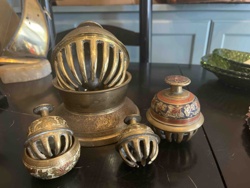
Approximately 5 inch diameter, brass bowl; origin unknown
These notes were written by the person who submitted this item. Appraiser.AI has not verified them, and the AI's identification and estimate may rely on them.
AI Estimated Value
Not an official valuation
$150-250
AI estimate as of November 24, 2025 · verify with a professional before acting
AI-Generated · Verify before acting
Everything on this page is generated by AI for informational purposes only. AI can make mistakes — the AI may misidentify items or misattribute them (artist, maker, brand, designer, origin, era). This is not an official valuation and should not be used for insurance, sale, tax, estate, legal, or lending purposes — or any decision requiring a certified appraisal. It is not an authoritative claim about any person, brand, or rights holder — do not share or rely on it as a factual statement about a third party. Always consult qualified professionals before making financial decisions.
This analysis also relies on unverified notes provided by the user, which may be incomplete or inaccurate and could affect the result.
This item is an antique or vintage brass singing bowl, measuring approximately 5 inches in diameter, perched upon a dark wooden surface with a visible grain. The bowl is crafted from brass, exhibiting a rich, warm golden-brown hue indicative of its material and age. Its finish is largely matte with a subtle sheen, suggesting a natural patina that has developed over time rather than a highly polished surface. The construction appears to be cast or hammered, with a smooth, rounded interior and exterior profile. The rim is gently rounded and appears consistent in thickness. A notable feature is the faint, intricate engraving visible on the interior bottom of the bowl. While the details are somewhat obscured by glare and wear, it appears to be a floral or sacred geometric pattern, possibly a mandala, characteristic of traditional Tibetan or Himalayan singing bowls. The engraving shows some signs of fading and surface wear, consistent with regular use or handling. There are no immediate visible cracks, dents, or major repairs, indicating a relatively good state of preservation for its presumed age. The overall condition suggests a well-cared-for item, with the patina adding to its character and authenticity. The craftsmanship, particularly the precision of the engraving despite its wear, points to a period of careful artisanal production. Origin is unknown, but the style is characteristic of objects produced in South Asia or the Himalayan region.
AI Appraisal Report
This engraved brass singing bowl, approximately 5 inches in diameter, presents as a charming example of its type. Based on my visual examination, the brass material displays a desirable warm, golden-brown hue with a matte finish and subtle sheen, indicative of a natural patina developed over time. The condition appears to be relatively good, with no visible cracks, dents, or major repairs. The crafting seems consistent with traditional methods, likely cast or hammered. While the intricate engraving on the interior bottom is somewhat obscured by glare and wear, it appears to be a floral or sacred geometric pattern, which is typical for Tibetan or Himalayan singing bowls. This wear is consistent with age and use, adding to its character rather than detracting significantly from its value.
Market conditions for vintage or antique singing bowls of this size and material are generally stable. Comparable bowls of similar diameter and decorative elements, especially those originating from Nepal or Tibet, typically fetch between $100 and $300, depending on the intricacy of the engraving, musical quality (which cannot be assessed visually), and confirmed provenance. Demand for such items is moderate, driven by collectors, practitioners, and those seeking decorative spiritual objects. Rarity is not exceptionally high for basic engraved brass bowls, but unique or exceptionally well-preserved examples can command higher prices.
A significant factor impacting its value is the lack of confirmed origin and the inability to assess its acoustic properties. Without physical inspection, I cannot confirm the precise age, metallurgical composition, or the actual musical tone produced by the bowl, which is a key aspect of value for a 'singing' bowl. Factors such as confirmed origin (e.g., specific region, era), a documented history of ownership (provenance), and an in-person acoustic evaluation would be crucial for full authentication and a more precise valuation. Without these, this appraisal is based purely on its aesthetic and apparent material quality, placing it in the decorative arts category with an assumption of its reported use.