AI estimate as of September 28, 2025 · verify with a professional before acting
AI-Generated · Verify before acting
Everything on this page is generated by AI for informational purposes only. AI can make mistakes — the AI may misidentify items or misattribute them (artist, maker, brand, designer, origin, era). This is not an official valuation and should not be used for insurance, sale, tax, estate, legal, or lending purposes — or any decision requiring a certified appraisal. It is not an authoritative claim about any person, brand, or rights holder — do not share or rely on it as a factual statement about a third party. Always consult qualified professionals before making financial decisions.
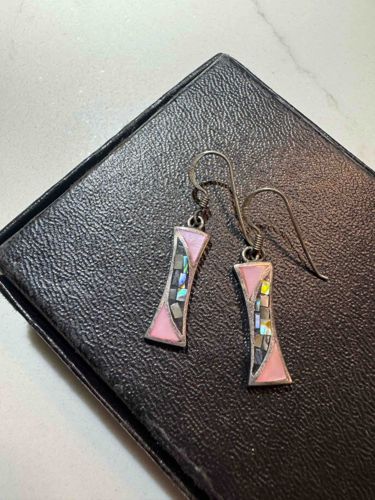
This is a pair of drop earrings featuring a geometric, bowed or hourglass-like pendant design, likely crafted from sterling silver based on the color and typical construction of such pieces. Each earring showcases a striking inlay pattern. The outer, broader sections of the pendant are inlaid with a solid, light pink material, possibly a type of resin, enamel, or a dyed natural stone, providing a soft, pastel contrast. The central, narrower section of each pendant is meticulously inlaid with small, rectangular or irregularly shaped pieces of iridescent material, strongly resembling mother-of-pearl or abalone shell. These inlay pieces exhibit a vibrant play of colors including blues, greens, purples, and grays, which shift with light and angle. The silver framework encases these inlaid sections, creating clean borders and a polished finish. The earrings are suspended from simple silver-toned ear wires, common for dangle or drop earrings. The overall condition appears good with some minor tarnishing visible on the ear wires, which is typical for silver jewelry and easily cleaned. No significant damage like chips, cracks, or missing inlay pieces are apparent. The craftsmanship indicates a good level of attention to detail, particularly in the precise cutting and fitting of the inlay segments. Given the style, these earrings likely date from the late 20th century to early 21st century, possibly with a southwestern or artisan-crafted aesthetic. They have a sleek yet decorative quality, making them versatile for both casual and more dressed-up occasions.
AI Appraisal Report
Based on my visual examination of the Pink and Mother-of-Pearl Inlay Sterling Silver Drop Earrings, I assess their condition as good, with some minor surface wear and typical tarnishing on the ear wires, common for sterling silver. The inlay work appears intact with no visible chips or missing pieces, indicating a decent level of craftsmanship. Authenticity as sterling silver cannot be definitively confirmed without physical testing (e.g., acid test or XRF analysis), but the color and typical construction suggest it is likely so. The pink material appears to be a resin or possibly a dyed stone, and the iridescent material is consistent with mother-of-pearl or abalone.
In terms of market conditions, similar new earrings featuring sterling silver and mother-of-pearl inlay from artisan or boutique brands typically retail for $80-$150. Pre-owned examples in good condition usually fetch 50-70% of their new retail price, depending on the venue. These earrings exhibit a contemporary artisan style, appealing to those who appreciate unique, handcrafted jewelry. Demand for sterling silver jewelry with natural material inlays remains steady, particularly for versatile pieces like these. They are not particularly rare; many artisans produce similar styles.
The primary factors impacting value are the material authenticity (specifically, confirming sterling silver content), the precise identity of the pink inlay material (natural stone vs. resin), and the overall quality of the inlay execution. Without in-person examination, I cannot verify the fineness of the silver, the exact composition of the pink inlay, or confirm that any potential hallmarks are present and authentic. A physical inspection would also allow for a more precise assessment of any subtle wear or structural integrity not visible in images.