These notes were written by the person who submitted this item. Appraiser.AI has not verified them, and the AI's identification and estimate may rely on them.
AI Estimated Value
Not an official valuation
$175-275
AI estimate as of July 25, 2025 · verify with a professional before acting
AI-Generated · Verify before acting
Everything on this page is generated by AI for informational purposes only. AI can make mistakes — the AI may misidentify items or misattribute them (artist, maker, brand, designer, origin, era). This is not an official valuation and should not be used for insurance, sale, tax, estate, legal, or lending purposes — or any decision requiring a certified appraisal. It is not an authoritative claim about any person, brand, or rights holder — do not share or rely on it as a factual statement about a third party. Always consult qualified professionals before making financial decisions.
This analysis also relies on unverified notes provided by the user, which may be incomplete or inaccurate and could affect the result.
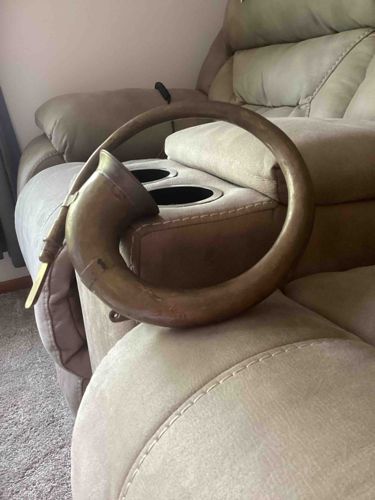
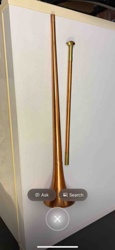
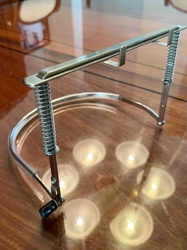
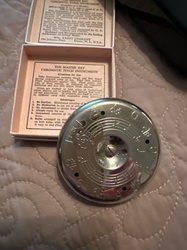
The item is an antique mechanical horn, likely a bulb horn or a similar early automotive signaling device. It appears to be constructed primarily of brass or a brass alloy, indicated by its characteristic golden-brown hue and the visible patina. The horn features a prominent, large bell or flare at one end, which then tapers down into a coiled, circular tube that forms the main body. This circular design suggests it was intended to fit compactly, possibly around a steering column or a similar structural element on a vehicle. The surface exhibits significant wear and oxidation, consistent with its age. There are areas where the brass has dulled, and some darker spots of tarnish are visible, particularly within the curves and crevices. The overall finish is a matte, aged metal, devoid of any significant polish or shine, which is typical for undisturbed antique brass. No obvious dents or major deformities are immediately apparent, suggesting a relatively good structural condition for its age, although minor surface abrasions or shallow scratches might be present under closer inspection. The absence of a rubber bulb, if it was originally a bulb horn, is a notable condition issue impacting its completeness and functionality. The overall craftsmanship suggests a utilitarian, yet well-formed, item, with attention paid to the smooth curving of the metal tubing. The manufacturing details, such as maker's marks or signatures, are not discernible from the provided images, but the style strongly aligns with early 20th-century automotive accessories, likely dating from the 1900s to 1920s.
AI Appraisal Report
Upon my virtual examination of this antique brass automotive horn, I assess its condition as good for its age, noting the characteristic golden-brown hue and visible patina consistent with aged brass. The absence of major dents or deformities indicates sound structural integrity. Its coiled, circular tubing and prominent bell are typical of early 20th-century automotive signaling devices, likely dating from the 1900s to 1920s.
Authenticity appears strong based on the visible wear, tarnish, and overall style, which align with historical examples of such horns. However, without a physical inspection, I cannot confirm the absence of modern repairs or alterations, nor can I definitively ascertain the exact brass alloy composition. The most significant factor impacting its completeness and functionality, and thus its value, is the absence of the original rubber bulb, if it was indeed a bulb horn.
Market conditions for antique automotive accessories are niche but stable, with demand driven by vintage car collectors and automobilia enthusiasts. Comparable sales for similar brass horns in good, unrestored condition without the original bulb typically range from $150 to $300. Demand is moderate, and while not exceedingly rare, original examples in this condition are becoming less common.
Limitations in authenticity verification from images alone are notable. A physical examination would allow me to check for internal structural integrity, assess the uniformity of the brass thickness, and search for faint maker's marks or serial numbers often obscured by patina. Provenance documentation, such as original sales receipts or historical vehicle photographs, would significantly enhance certainty regarding its age and origin. Scientific testing, like X-ray fluorescence (XRF), could confirm the specific alloy and rule out modern materials. The primary factor depressing value is the missing bulb. If a suitable period-correct replacement bulb could be sourced and expertly fitted, its value would notably increase.