AI estimate as of October 22, 2025 · verify with a professional before acting
AI-Generated · Verify before acting
Everything on this page is generated by AI for informational purposes only. AI can make mistakes — the AI may misidentify items or misattribute them (artist, maker, brand, designer, origin, era). This is not an official valuation and should not be used for insurance, sale, tax, estate, legal, or lending purposes — or any decision requiring a certified appraisal. It is not an authoritative claim about any person, brand, or rights holder — do not share or rely on it as a factual statement about a third party. Always consult qualified professionals before making financial decisions.
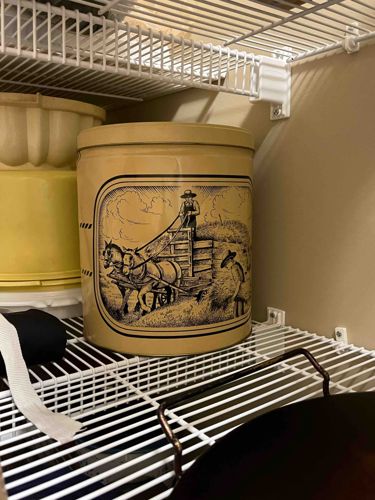
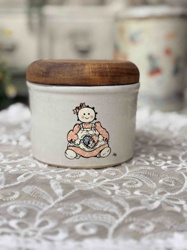
This is a vintage tin canister, cylindrical in shape, with a slightly tapered body and a fitted lid, likely designed for kitchen storage. The primary color of the canister is a warm, muted tan or beige, which serves as the background for a prominent black and white, or possibly sepia-toned, illustration of a classic farm scene. The illustration depicts a farmer standing on a hay wagon, being pulled by a team of two horses, with another figure, possibly a farmhand or a child, visible in the foreground to the right, sitting amidst some harvested hay or crops. The style of the illustration suggests an aesthetic from the mid-20th century, possibly the 1950s to 1970s, characteristic of nostalgic Americana or country-style decor. The edges of the illustration are framed by a simple black border, adding to its defined appearance. The construction appears to be machine-made tin, common for durable food storage containers of that era. Visible condition issues are minor, with some slight scuffs or discoloration on the tan background, as expected with age and use, but no significant dents, rust, or major paint loss are discernible from the image. The lid appears to be a separate, friction-fit piece. Without closer inspection, specific manufacturing marks are not visible, but these types of canisters were mass-produced. The craftsmanship is utilitarian but decorative, reflecting a period when everyday items often featured charming, pictorial designs. The overall aesthetic is one of rustic charm and functionality.
AI Appraisal Report
Based on my visual examination of the provided image, this vintage tin canister, featuring a farm scene illustration, appears to be an authentic example of mid-20th-century kitchenware. The slightly tapered body, friction-fit lid, and machine-made tin construction are consistent with common utilitarian designs from the 1950s-1970s. The black and white/sepia-toned farm scene with the farmer on a hay wagon pulled by horses reflects the popular nostalgic Americana aesthetic of the era. Condition appears to be good for its age; I note only minor scuffs and discoloration on the tan background, which are expected and do not significantly detract from its appeal. There are no visible major dents, rust, or significant paint loss.
Market conditions for such vintage kitchen canisters are generally stable but not exceptionally strong. Comparable items, often found at antique malls, flea markets, or online vintage marketplaces, typically retail in the $15-$50 range, depending on condition, specific design, and desirability of the imagery. While charming, these types of canisters are not exceptionally rare as they were mass-produced. Demand is driven primarily by collectors of vintage kitchenalia, country-style decor enthusiasts, or individuals seeking nostalgic everyday items. The pleasant illustration and good state of preservation contribute positively to its value.
My assessment of authenticity is based solely on visual characteristics from the image. For a full authentication, I would require an in-person examination to check for any hidden damage, confirm material composition, and inspect for manufacturing marks that might indicate a specific maker or production date. Provenance documentation could also offer insights into its history, though this is less common for mass-produced items of this value range. Without physical inspection, I cannot rule out the possibility of a modern reproduction, though its aesthetic strongly suggests vintage.