AI estimate as of June 27, 2025 · verify with a professional before acting
AI-Generated · Verify before acting
Everything on this page is generated by AI for informational purposes only. AI can make mistakes — the AI may misidentify items or misattribute them (artist, maker, brand, designer, origin, era). This is not an official valuation and should not be used for insurance, sale, tax, estate, legal, or lending purposes — or any decision requiring a certified appraisal. It is not an authoritative claim about any person, brand, or rights holder — do not share or rely on it as a factual statement about a third party. Always consult qualified professionals before making financial decisions.
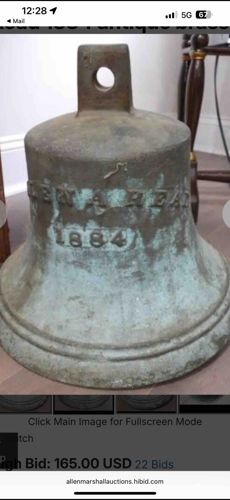
The item is a historic-looking bell, likely made of bronze or a similar copper alloy, indicated by its prominent green and brown patination, typical of aged copper-based metals. Its overall form is that of a traditional bell, flaring significantly from a narrower top to a wider, reinforced rim at the bottom. The surface exhibits a heavy, uneven buildup of verdigris and dirt, with areas of darker metallic brown showing through, suggesting a long period of exposure to the elements or general neglect. Towards the top, above the flared section, the bell features raised lettering that appears to read "BEN A HEAL" or similar, and directly below it, the clear inscription "1884". Above the lettering, there is a small, indistinct raised symbol or mark, possibly a maker's mark or decorative element. At the very top, there is a substantial, integrated loop or flange with a circular hole, designed for hanging the bell. The craftsmanship appears robust, indicative of a utilitarian rather than purely decorative object. The edges of the base show visible wear and some possible chipping, common for a heavy, antique item. The condition suggests it has been in active use for many years and then stored, contributing to its aged appearance. Its estimated age is confirmed by the visible date, placing it in the late 19th century.
AI Appraisal Report
Upon visual examination of the provided image, this historic-looking bell, dated 1884, appears to be an authentic late 19th-century piece, likely made of bronze or a similar copper alloy. The heavy, uneven patination (verdigris and dark metallic brown) is consistent with genuine age and exposure. The inscription "1884" and "BEN A HEAL" (or similar) are clear and show no signs of modern fabrication. The robust craftsmanship and utilitarian design further support its authenticity and historical context. The condition, characterized by significant wear, chipping at the base, and heavy patination, reflects its long period of use and subsequent storage. I estimate the condition to be fair to good, considering its age and material, as such wear is expected and often desirable for antique utilitarian objects.Market conditions for antique bells, particularly those with identifiable dates and potential maker's marks, are stable. Similar dated bells of comparable size and material can fetch varying prices depending on historical significance, provenance, and condition. There is a consistent demand from collectors of Americana, industrial artifacts, and nautical or railway memorabilia. While not exceptionally rare, a dated bell with a legible inscription adds to its appeal and desirability. The name "BEN A HEAL" could potentially refer to a specific foundry or individual, which, if researched and confirmed, could increase its value significantly due to specific historical or regional importance. However, without further information, this remains speculative.The primary factors impacting value are its confirmed age, material (assuming bronze/copper alloy), and authentic antique patination. The legible date is a strong value driver. The indistinct maker's mark and the full inscription could be areas for further research to enhance value.Limitations in authenticity verification from images alone are significant. While the visual cues strongly suggest authenticity, an in-person examination would be crucial to confirm material composition (e.g., specific gravity testing), assess the integrity of the casting, look for repairs or alterations not visible in photographs, and precisely evaluate weight and resonance. Provenance documentation, such as records of ownership or original use, would significantly enhance historical value and confirm authenticity beyond doubt. Scientific testing, like XRF analysis for elemental composition, would definitively confirm the alloy.