AI estimate as of August 1, 2025 · verify with a professional before acting
AI-Generated · Verify before acting
Everything on this page is generated by AI for informational purposes only. AI can make mistakes — the AI may misidentify items or misattribute them (artist, maker, brand, designer, origin, era). This is not an official valuation and should not be used for insurance, sale, tax, estate, legal, or lending purposes — or any decision requiring a certified appraisal. It is not an authoritative claim about any person, brand, or rights holder — do not share or rely on it as a factual statement about a third party. Always consult qualified professionals before making financial decisions.
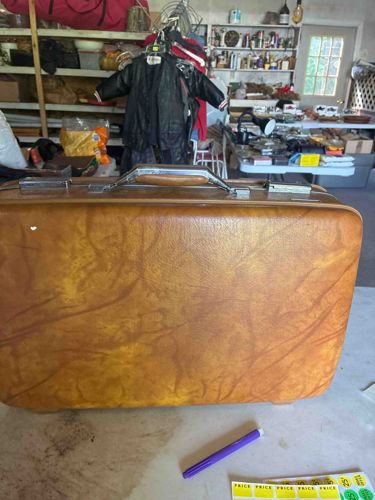
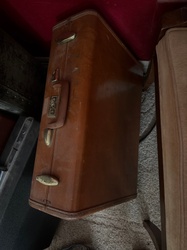
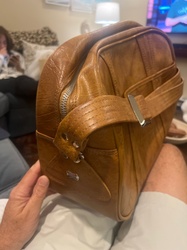
This is a vintage-style hard-shell suitcase, likely dating from the mid-20th century, possibly the 1950s to 1970s, based on its design and materials. It features a trapezoidal shape, wider at the base than the top, a common design element for suitcases of that era. The exterior is covered in a material that appears to be faux leather or a molded plastic, imitating a leather texture in a medium to dark tan or caramel color. The surface shows considerable wear, with prominent scuffs, scratches, and a cloudy, mottled appearance that suggests aging and repeated use. There are visible stress lines and creases, particularly towards the bottom edges, indicating areas where the material has been flexed or scuffed. A small, lighter mark, possibly a scuff or abrasion, is visible on the upper left side of the main body. The construction appears to be rigid, suggesting a hard-sided case, possibly made with a wood or fiberboard core. The hardware consists of a top-mounted handle assembly made of what looks like chrome-plated metal, showcasing a curved, angular design. The handle itself has a wooden or bakelite grip in a contrasting lighter brown color, adding a touch of warmth and ergonomic detail. The metal hardware, while showing some reflections, appears to be in relatively good condition with no obvious signs of severe corrosion or damage from the visible angle. While the interior is not visible, these types of suitcases typically feature fabric linings, often satin or rayon, with elasticized pockets or straps. The overall condition suggests this item has been well-used and shows the expected patina and wear of a vintage travel accessory.
AI Appraisal Report
Based on my examination of the provided image, this vintage hard-shell suitcase, likely from the mid-20th century (1950s-1970s), exhibits significant wear consistent with its age and intended use. The trapezoidal shape and faux leather exterior are characteristic of the era. The surface shows prominent scuffs, scratches, and a mottled appearance, indicating considerable handling and aging. The handle, with its chrome-plated metal and wooden/bakelite grip, appears to be relatively intact, which is a positive factor.
Authenticity: From images alone, I can assess the item appears to be an authentic vintage piece, not a modern reproduction, due to the specific type of wear and materials used. However, definitive authentication would require in-person examination to assess material composition, internal construction (e.g., wood or fiberboard core), and hardware attachments. Provenance documentation, such as original purchase receipts or family history, would further solidify its history.
Market Conditions and Comparables: Vintage hard-shell suitcases, especially those with visible wear, typically have a modest market. Comparables on online marketplaces and at antique shops show similar condition pieces ranging from $30 to $100. Cases in excellent, near-new condition, or those from highly collectible brands (which this does not appear to be) fetch higher prices.
Demand and Rarity: There is a steady, but not high, demand for vintage luggage for decorative purposes, prop use, or light travel. This specific design is not particularly rare. The significant wear, while authentic, limits its appeal to collectors seeking pristine examples and reduces its value.
Factors Impacting Value: The primary factor impacting value is its condition; the extensive scuffs, scratches, and mottling significantly reduce its monetary worth. While these are part of its "patina," they detract from market value. The absence of visible interior condition also leaves an unknown. If the interior is severely compromised (e.g., rips, mold, strong odors), the value would decrease further. Conversely, a clean, intact interior could slightly increase value.
Limitations: My assessment is limited to the visual information available. Without a physical inspection, I cannot verify the integrity of the shell, the functionality of latches (if present and not obscured by the angle), the material composition with certainty, or the internal condition. Scientific testing would be needed to confirm material composition (e.g., specific plastics or faux leather types) for more precise dating, though generally not cost-effective for an item of this value.