These notes were written by the person who submitted this item. Appraiser.AI has not verified them, and the AI's identification and estimate may rely on them.
AI Estimated Value
Not an official valuation
$250 - $400
AI estimate as of September 5, 2025 · verify with a professional before acting
AI-Generated · Verify before acting
Everything on this page is generated by AI for informational purposes only. AI can make mistakes — the AI may misidentify items or misattribute them (artist, maker, brand, designer, origin, era). This is not an official valuation and should not be used for insurance, sale, tax, estate, legal, or lending purposes — or any decision requiring a certified appraisal. It is not an authoritative claim about any person, brand, or rights holder — do not share or rely on it as a factual statement about a third party. Always consult qualified professionals before making financial decisions.
This analysis also relies on unverified notes provided by the user, which may be incomplete or inaccurate and could affect the result.
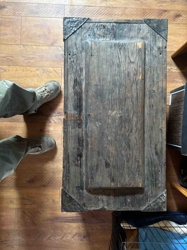
This is a vintage carpenter's tool chest, likely dating from the late 19th century. The chest is constructed primarily from dark-stained wood, possibly pine or oak, judging by the visible grain and the common materials used for such utility items during that period. It exhibits a rectangular form with a slightly raised, flat lid, which appears to be constructed of multiple planks. The overall color is a very dark brown, almost black, with areas of lighter, worn wood showing through, indicating significant age and use. The construction features visible, reinforced corners, possibly with metal or heavier timber straps, secured with nails or screws. The corners of the lid also show angular wooden reinforcements. The chest rests on a simple, integrated wooden base or plinth, providing a separation from the floor.
Observable condition issues include extensive wear, scratches, and abrasions across all surfaces, consistent with its intended use as a durable and portable storage unit for tools. There are visible chips and small areas of missing wood, particularly along the edges and corners, contributing to its authentic, aged patina. No obvious repairs are immediately discernible, suggesting it retains much of its original construction. The craftsmanship appears robust and functional, rather than decorative, with an emphasis on durability and utility, typical of utilitarian objects from this era. There are no visible maker's marks or signatures in the provided images, but the overall design aligns with common carpenter's chests of the period.
AI Appraisal Report
Upon examining the images of this late 19th-century carpenter’s tool chest, I assess it to be a genuine utilitarian piece from the period. Its construction from dark-stained pine or a similar wood, featuring dovetailed or reinforced corners and a simple, robust design, is consistent with American or European woodworking traditions of the 1800s. The extensive wear, including scratches, abrasions, and chips, contributes to a desirable, authentic patina that speaks to a long life of use. This heavy wear is expected and often preferred by collectors over refinished pieces, as it substantiates its history. The chest appears to be in sound, original condition without obvious major repairs or alterations.
The market for antique utilitarian items like this has a steady but specific collector base. While not as rare as decorative cabinetry from the same era, well-preserved examples remain in demand for their rustic and historical appeal, often used as decorative pieces like coffee tables or console storage. Comparable chests in similar 'as-found' condition typically sell in the $250 to $400 range at auction and in antique marketplaces. The value is primarily driven by its decorative potential and authenticity. The lack of a maker's mark or any unique internal fittings (like intricate till arrangements) prevents it from reaching a higher valuation.
It is important to note that this appraisal is based solely on images. A physical, in-person examination would be required to definitively confirm the type of wood, the joinery techniques used (e.g., hand-cut dovetails), and to search for any hidden maker's marks or labels that would significantly impact its value and provenance. Without such inspection, full authentication cannot be guaranteed.