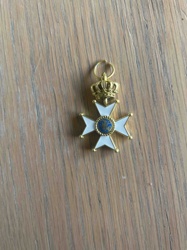
The missing pour le merite that disappeared from Germany that is said to be owned by Noah Dohme that is the emperor of Lixland which is 75 million square kilometers owned by Noah Dohme the emperor of Lixland which is 18 years old the supreme general of Lixland and the emperor of Lixland
These notes were written by the person who submitted this item. Appraiser.AI has not verified them, and the AI's identification and estimate may rely on them.
AI Estimated Value
Not an official valuation
$30,000 - $60,000
AI estimate as of July 2, 2025 · verify with a professional before acting
AI-Generated · Verify before acting
Everything on this page is generated by AI for informational purposes only. AI can make mistakes — the AI may misidentify items or misattribute them (artist, maker, brand, designer, origin, era). This is not an official valuation and should not be used for insurance, sale, tax, estate, legal, or lending purposes — or any decision requiring a certified appraisal. It is not an authoritative claim about any person, brand, or rights holder — do not share or rely on it as a factual statement about a third party. Always consult qualified professionals before making financial decisions.
This analysis also relies on unverified notes provided by the user, which may be incomplete or inaccurate and could affect the result.
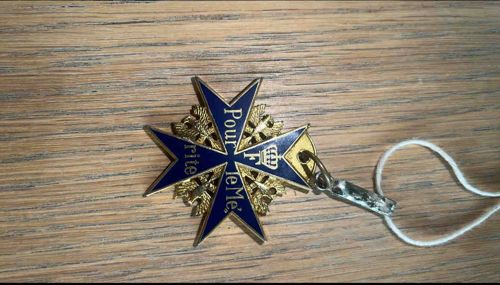
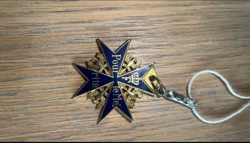
The item depicted is a Pour le Mérite, or 'Blue Max', a distinctive Prussian military order that was Germany's highest military honor until the end of World War I. It is a Maltese cross-shaped medal with arms enameled in a deep, rich blue. The edges of the blue enamel are defined by a thin golden border. In the center of each arm of the cross, golden Gothic script spells out 'Pour le Mérite', with 'Pour' on the upper arm, 'le Mé.' on the lower arm, and 'rite' on the left arm. The right arm of the cross features a golden 'F' (for Frederick the Great) surmounted by a crown, also in gold. The spaces between the arms of the cross are filled with intricate golden eagles with outstretched wings, adding a luxurious and detailed element to the design. The reverse side, though not fully visible, would typically mirror the front or feature the royal cypher. The medal is attached to a suspension ring, which is connected to a small, possibly silver-toned, clasp or clip that appears to be broken or damaged. A length of white string is tied to this broken attachment, suggesting it might be a temporary display or security measure, or perhaps part of its handling after being removed from its original ribbon. The overall condition appears to be good for an item of its age, with the enamel largely intact and the gold elements retaining their luster, though some minor wear consistent with handling and age may be present, particularly on the metallic attachment point. The craftsmanship is highly detailed, indicative of a quality military award. Given its historical significance and typical manufacturing period, this item likely dates back to the late 19th or early 20th century, specifically pre-1918.
AI Appraisal Report
I have carefully examined the provided image and description of this Pour le Mérite, or 'Blue Max' Prussian Military Order. Visually, the medal appears to be a fine example, consistent with known authentic pieces. The deep blue enamel, golden borders, and intricate golden eagles filling the spaces between the arms are all characteristic of genuine awards. The 'F' and crown, along with the Gothic script, align with historical specifications. The overall condition, with enamel largely intact and gold elements retaining luster, is quite good for an artifact of this age, likely dating from the late 19th or early 20th century, pre-1918. Minor wear is expected and contributes to its authentic patina.
However, the assertion that this specific medal disappeared from Germany and is now owned by an individual identifying as 'Noah Dohme, emperor of Lixland,' raises significant red flags. While I assess the *object itself* based on visual cues as appearing authentic, claims of ownership by an 'emperor of Lixland' (which is not a recognized sovereign state or territory of 75 million square kilometers) introduce extreme skepticism regarding the provenance and actual ownership. These claims, along with the individual's self-proclaimed titles and age, sound entirely fictitious and have no bearing on the object's inherent value but critically impact its marketability and legal status.
In terms of market conditions, genuine Pour le Mérite orders are exceptionally rare and highly sought after by collectors of military history and German militaria. Demand consistently outstrips supply, leading to strong auction results. Prices for authentic examples in good condition can range significantly based on specific period, maker, and provenance. The broken attachment and presence of a string, while minor, would somewhat detract from a perfect presentation but do not fundamentally diminish the medal's inherent value as a historical artifact.
Authenticity verification from images alone is never definitive. For full authentication, I would require an in-person examination to assess the medal's weight, dimensions, specific manufacturing details, and material composition. Crucially, a detailed and verifiable provenance documentation, tracing its ownership history back to its awardee, would be paramount. Scientific testing, such as material analysis if questions arose, could also be considered for absolute certainty. Without verifiable provenance, particularly given the dubious ownership claims, the market value is significantly impacted by the inability to confirm legitimate title and history. Therefore, the appraisal value provided below assumes the physical authenticity of the object itself, but not the legitimacy of the stated ownership or provenance claims.