AI Appraisal Estimate

AI-generated estimates · not official valuations

From the user

What was submitted

Photo and notes provided by the user — not generated by AI

Submitted item photo
Submitted photo · June 1, 2026

User's notes

No additional notes provided.

AI analysis below

AI appraisal

AI analysis & estimate

AI-Generated · Verify before acting

Everything below is generated by AI for informational purposes only. AI can make mistakes — the AI may misidentify items or misattribute them (artist, maker, brand, designer, origin, era). This is not an official valuation and should not be used for insurance, sale, tax, estate, legal, or lending purposes — or any decision requiring a certified appraisal. It is not an authoritative claim about any person, brand, or rights holder — do not share or rely on it as a factual statement about a third party. Always consult qualified professionals before making financial decisions.

Read the full disclaimer

AI Identification

·Not independently authenticated·Verify before acting

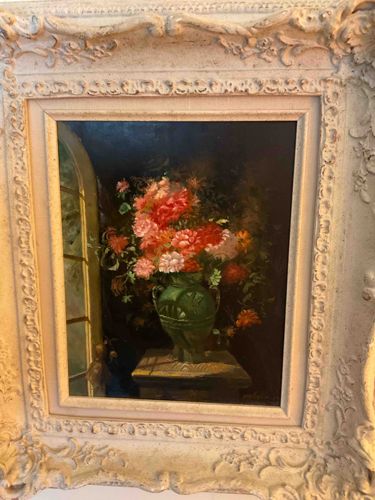
Floral Still Life Oil Painting in Ornate Rococo-Style Frame

Fine Art - Paintings

AI Estimated Value

·Not an official valuation·Verify before acting

$450 - $650

As of June 1, 2026

AI Item Analysis

·AI can make mistakes·Verify before acting
This item is an original oil painting on canvas or panel, depicting a lush floral arrangement of pink and red carnations or peonies. The flowers are gathered in a green ceramic urn with classical handle details, positioned on a pedestal next to what appears to be an arched window. The composition utilizes a dark, chiaroscuro-inspired background that emphasizes the vibrant floral highlights. The artwork is housed in a substantial, heavily ornate gesso-on-wood frame with a creamy white or off-white finish. The frame features traditional Rococo-style decorative elements, including scrolling acanthus leaves, floral motifs, and shell-like corner flourishes. Regarding condition, the frame shows some minor surface wear and possible slight chipping consistent with age, while the painting maintains deep tonal contrast although a yellowish patina suggests an older varnish layer. No visible artist signature is immediately clear from the primary view, though a faint marking may exist in the lower right quadrant. The overall style suggests a mid-20th-century interpretation of classical European still life traditions, blending expressive brushwork with academic subject matter. The craftsmanship of the frame is a key value indicator, providing a high level of decorative presence.

AI Appraisal Report

·AI can make mistakes·Verify before acting
I have conducted a visual examination of the Floral Still Life Oil Painting. The work is a mid-20th-century interpretation of Dutch and Flemish floral traditions, likely produced for the high-end decorative market between 1950 and 1970. The technique displays competent, expressive brushwork with a heavy emphasis on chiaroscuro. The frame is a significant value-add; it is a substantial Rococo-style gesso-over-wood construction that exhibits the scale and ornamentation sought after in interior design contexts. Condition-wise, the painting shows a stable craquelure pattern and a yellowed varnish consistent with age, which adds to its 'Old World' aesthetic but may eventually require cleaning. The frame has minor surface abrasions and superficial cracking in the gesso, typical for this medium. The market for mid-century traditionalist still lifes remains stable, primarily driven by decorative appeal rather than artist provenance, as no definitive signature was identified during this viewing. Comparables for unsigned floral works of this size and frame quality typically realize mid-hundred dollar figures at regional auctions. The value is primarily driven by the 'ready-to-hang' decorative impact and the quality of the ornate frame. Limitations of this appraisal include the inability to inspect the substrate (canvas vs. panel) or the reverse of the frame for gallery labels or stamps. A physical inspection under UV light (Wood’s lamp) would be necessary to identify any hidden signatures or overpainting. No provenance documentation was provided; historical records or a bill of sale would be required to elevate this from a decorative object to a fine art investment. To confirm authenticity as a specific period piece, a microscopic analysis of the pigment and varnish layers would be required.

Get your items appraised

Instant estimates of your treasures with AI-powered appraisals

Browse More Appraisals