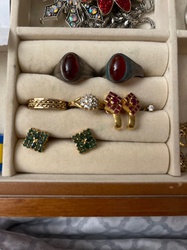
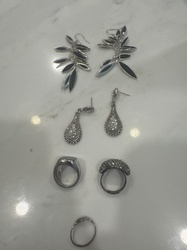
These notes were written by the person who submitted this item. Appraiser.AI has not verified them, and the AI's identification and estimate may rely on them.
AI Estimated Value
Not an official valuation
$650 - $1,100
AI estimate as of September 1, 2025 · verify with a professional before acting
AI-Generated · Verify before acting
Everything on this page is generated by AI for informational purposes only. AI can make mistakes — the AI may misidentify items or misattribute them (artist, maker, brand, designer, origin, era). This is not an official valuation and should not be used for insurance, sale, tax, estate, legal, or lending purposes — or any decision requiring a certified appraisal. It is not an authoritative claim about any person, brand, or rights holder — do not share or rely on it as a factual statement about a third party. Always consult qualified professionals before making financial decisions.
This analysis also relies on unverified notes provided by the user, which may be incomplete or inaccurate and could affect the result.
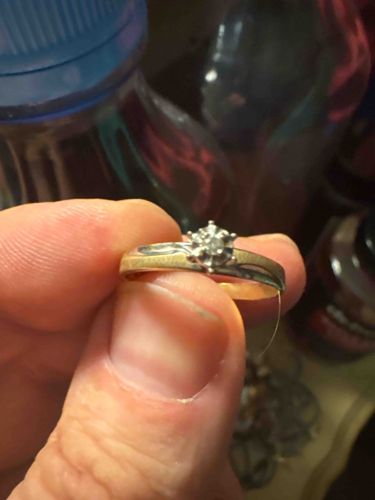
The item is a finger ring, likely an engagement or solitaire ring, featuring a single prominent gemstone set within a multi-pronged head, specifically a six-prong setting. The band appears to be crafted from two different metals: an inner band of yellow gold and an outer, possibly decorative, layer or accent of white gold or silver-toned metal on the upper half, forming a bypass or split-shank style that cradles the central setting. The yellow gold portion shows a smooth, polished finish, while the lighter-toned metal on the shoulders of the band has a subtle engraved or textured pattern visible, adding visual interest. The gemstone, presumably a diamond given the setting style, is round brilliant cut; its facets are visible, reflecting light. The overall condition appears fair to good, with some visible wear consistent with regular use, such as minor scratches on the metal band, particularly the high points of the yellow gold. There are no obvious signs of significant damage like chips on the stone or major deformations of the band. The craftsmanship appears to be of standard commercial quality, typical of mass-produced jewelry from the late 20th to early 21st century. The size is difficult to ascertain precisely without a scale, but it appears to be a standard ladies' ring size being held between an adult's thumb and index finger. No specific maker's marks or hallmarks are discernible from the provided image.
AI Appraisal Report
Based on my visual examination of the provided image, I have assessed this Two-Tone Solitaire Ring. The item presents as a classic solitaire design with a round brilliant cut gemstone secured in a six-prong setting. The two-tone metal construction, featuring what appears to be yellow gold for the inner band and a white metal (likely white gold given the context of such rings) for the outer accent and setting, adds visual interest. The yellow gold band exhibits a smooth, polished finish, while the white metal shoulders show a subtle textured or engraved pattern.
In terms of condition, I observe fair to good wear consistent with regular use. There are minor surface scratches visible on the metal, particularly on the prominent yellow gold band, which is typical for a worn ring. I do not discern any major damage to the band or obvious chips on the gemstone from the image. The craftsmanship appears to be of standard commercial quality, typical of mass-produced jewelry.
Authenticity verification from images alone has limitations. While the gemstone's facets suggest it is a diamond, I cannot definitively confirm its authenticity (natural vs. synthetic) or exact quality (clarity, color, carat weight) without in-person examination utilizing gemological tools. Similarly, metal purity (e.g., 14K, 18K gold) cannot be confirmed without hallmarks or testing.
Market conditions for solitaire rings remain stable. Demand is consistent, particularly for classic designs. Rarity is low due to the mass-produced nature of such items. Factors impacting value include the actual carat weight and quality of the gemstone, the karatage of the gold, and the overall condition. For a full authentication and precise valuation, an in-person gemological assessment to verify the gemstone (type, 4Cs), metal composition, and a thorough condition check for hidden wear or repairs would be necessary. Without this, I am valuing it based on the assumption of a natural diamond, likely in the 0.50-0.75 carat range, and standard gold alloys, considering the commercial quality and visible wear.