AI estimate as of October 14, 2025 · verify with a professional before acting
AI-Generated · Verify before acting
Everything on this page is generated by AI for informational purposes only. AI can make mistakes — the AI may misidentify items or misattribute them (artist, maker, brand, designer, origin, era). This is not an official valuation and should not be used for insurance, sale, tax, estate, legal, or lending purposes — or any decision requiring a certified appraisal. It is not an authoritative claim about any person, brand, or rights holder — do not share or rely on it as a factual statement about a third party. Always consult qualified professionals before making financial decisions.
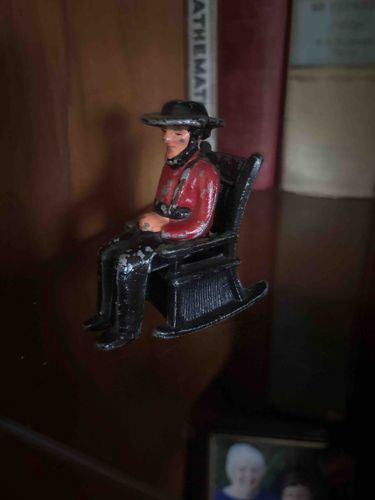
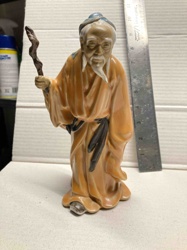
This item is a vintage cast-iron figurine depicting a man seated in a rocking chair. The figure appears to be made from a single mold of dark-colored metal, likely cast iron, and subsequently hand-painted with varying degrees of detail and finish. The man is depicted wearing a wide-brimmed black hat, a red shirt or jacket, and dark trousers. His face is painted with light skin tones, and there are visible features for eyes, nose, and mouth, although the details are somewhat crude and worn. A dark-colored scarf or cravat is visible around his neck. He appears to have dark straps, possibly suspenders, over his red shirt. His hands, also painted in skin tone, are resting on his lap. The rocking chair is entirely black and features a slatted back and seat, typical of traditional wooden rocking chairs, but rendered in metal. Both the figure and the chair show significant wear to the painted surfaces, with numerous chips, scratches, and areas where the underlying dark metal is exposed. This wear suggests considerable age and handling. The figurine has a folk art or toy-like quality, characteristic of early 20th-century cast iron production, often used for decorative purposes or as doorstops. The craftsmanship is robust and functional for its intended purpose, but not highly refined in terms of artistic detail. The overall condition, despite paint loss, indicates a sturdy construction that has withstood the test of time.
AI Appraisal Report
Upon examining the image of this Vintage Cast Iron Man in Rocking Chair Figurine, I assess its condition as fair to good, consistent with its age and material. The significant paint loss, chips, and scratches are indicative of a well-used or displayed item, but the underlying cast iron structure appears sound, confirming its robust construction. This wear is expected for items of this type, often used as doorstops or decorative accents, and does not detract significantly from its vintage appeal; rather, it authenticates its antiquity.
Authenticity, based purely on visual examination, appears strong for a vintage cast iron piece. The crude hand-painting, typical molding characteristics, and visible wear patterns align with early 20th-century folk art or toy production standards. There's nothing to suggest it's a modern reproduction. Market conditions for vintage cast iron figurines of this nature are stable, with a moderate collector base. Comparables, such as other painted cast iron doorstops or small decorative figures from the same period, typically fetch prices within this range, depending on condition, rarity, and aesthetic appeal. While it possesses a charming, somewhat whimsical quality, it doesn't represent a highly sought-after or rare design, impacting its top-end value. The lack of maker's marks or specific historical attribution also limits its premium. Demand is steady among collectors of Americana and antique folk art, but not exceptionally high. The main factors impacting its value are its intact form despite paint loss and its genuine vintage appeal.
Limitations in authenticity verification from images alone are crucial to acknowledge. Without physical inspection, I cannot confirm the exact metal composition, weight, or detect any repairs or alterations that might affect its structural integrity or originality. An in-person examination would allow for closer inspection of paint layers to determine originality and potential overpainting, as well as searching for any faint casting marks. Provenance documentation, detailing its history of ownership, would further enhance its value and confirm its age and origin fully. Scientific testing, such as metallurgy analysis, would be necessary for absolute authentication of material composition, but for an item of this type, it's generally not practical or expected unless a dispute arose regarding its authenticity.