AI estimate as of August 19, 2025 · verify with a professional before acting
AI-Generated · Verify before acting
Everything on this page is generated by AI for informational purposes only. AI can make mistakes — the AI may misidentify items or misattribute them (artist, maker, brand, designer, origin, era). This is not an official valuation and should not be used for insurance, sale, tax, estate, legal, or lending purposes — or any decision requiring a certified appraisal. It is not an authoritative claim about any person, brand, or rights holder — do not share or rely on it as a factual statement about a third party. Always consult qualified professionals before making financial decisions.
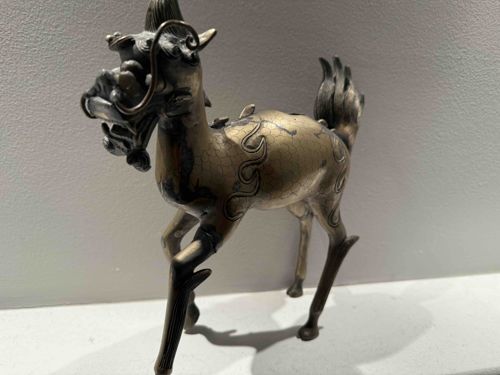
This item is a bronze or brass censer, likely cast, fashioned in the form of a mythical creature. The creature exhibits characteristics reminiscent of a Qilin or a mythical deer, possessing a horse-like body with slender legs, cloven hooves, and a prominent, flame-like tail. The head is highly stylized, resembling a dragon or fantastical beast with an open mouth, visible teeth, and small horns or protrusions above its eyes. A distinctive feature is the ring or loop extending from its mouth, suggesting it may have been part of a larger censer assembly or used for handling. The body of the creature is intricately decorated with etched or engraved swirling patterns, possibly representing clouds, flames, or auspicious symbols, creating a sense of movement across its surface. The metal displays a varied patination, primarily a dark, antique brass or bronze hue with lighter, shinier areas where the metal has been worn or polished over time, particularly along raised edges and high points of its body and features. Some specks of green corrosion (verdigris) are visible in crevices, indicating age and the composition of the metal. There is evidence of possible cracking or separation along the back, running longitudinally down the spine, which could be a casting flaw, age-related stress, or a repair. The overall craftsmanship suggests a piece of moderate to high quality, with attention to detail in the anatomical features and surface decoration. Given its form and style, it likely dates from an East Asian cultural context, possibly from the Qing Dynasty or an earlier period, intended for fragrant incense burning or purely for aesthetic display.
AI Appraisal Report
I have carefully examined the provided image of this bronze or brass censer, fashioned in the form of a mythical creature. The craftsmanship, with its intricate etched patterns and stylized features, suggests a piece of moderate to high quality, likely from an East Asian cultural context, possibly Qing Dynasty or earlier. The varied patination, dark bronze hue with lighter worn areas, and specks of verdigris support its age.
From the image, the condition appears good for its age, though I note a concerning longitudinal crack or separation along the back. This could be a casting flaw, age-related stress, or a past repair. Its impact on value depends on its stability and origin. The ring from the mouth suggests it was part of a larger assembly or for handling.
In terms of market conditions, mythical beast bronzes, particularly censers, from Asian dynasties retain steady demand among collectors of decorative arts and Asian antiquities. Comparables include similar Qilin or Buddhist lion censers which, depending on size, period, and quality, can range significantly.
Demand is moderate for such pieces, with rarity increasing for examples with exceptional provenance, artistic merit, or historical significance. This piece's unique form, reminiscent of a deer or Qilin, adds to its appeal.
Limitations in authenticity verification from images alone are significant. While the visible characteristics are consistent with an antique Asian bronze censer, definitive authenticity requires in-person examination to assess the metal composition, casting techniques, and patination more thoroughly. Provenance documentation, such as purchase records or exhibition history, would be crucial. Scientific testing, like XRF analysis for metal composition or thermoluminescence dating for attached elements (if applicable), could provide further certainty. Without physical inspection, I cannot definitively rule out later reproductions or significant repairs.